
| Date | 350 BCE |
| Place of origin | Greece |
| Culture/Period | Greece |
| Material/Technique | Bronze |
| Dimensions | 150 cm or 59 inches in height |
| Current location | The Cleveland museum of art |
| Licence | CC0 |
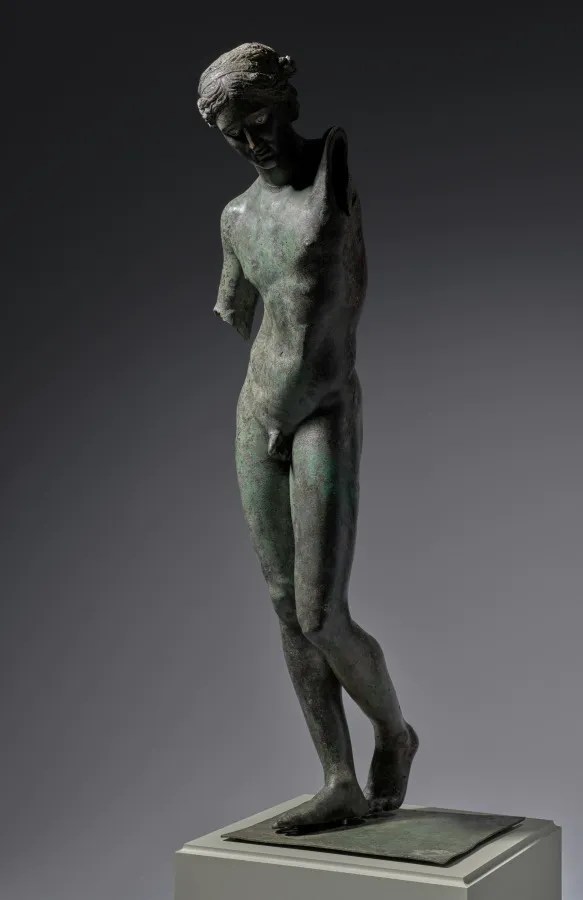
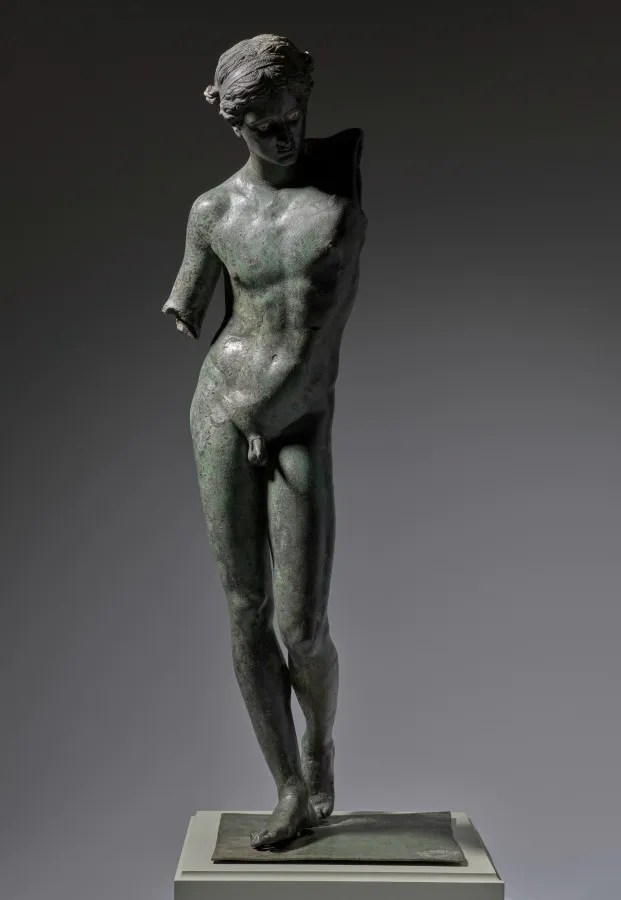
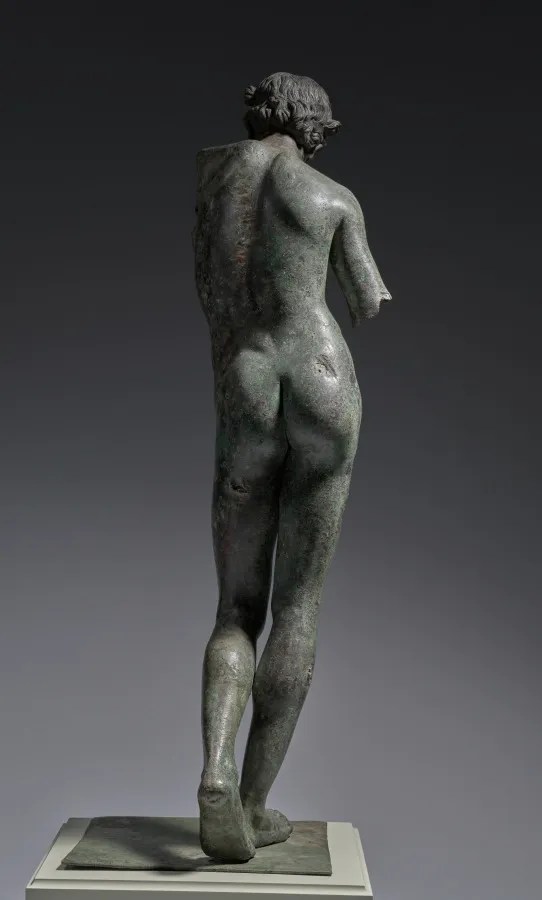
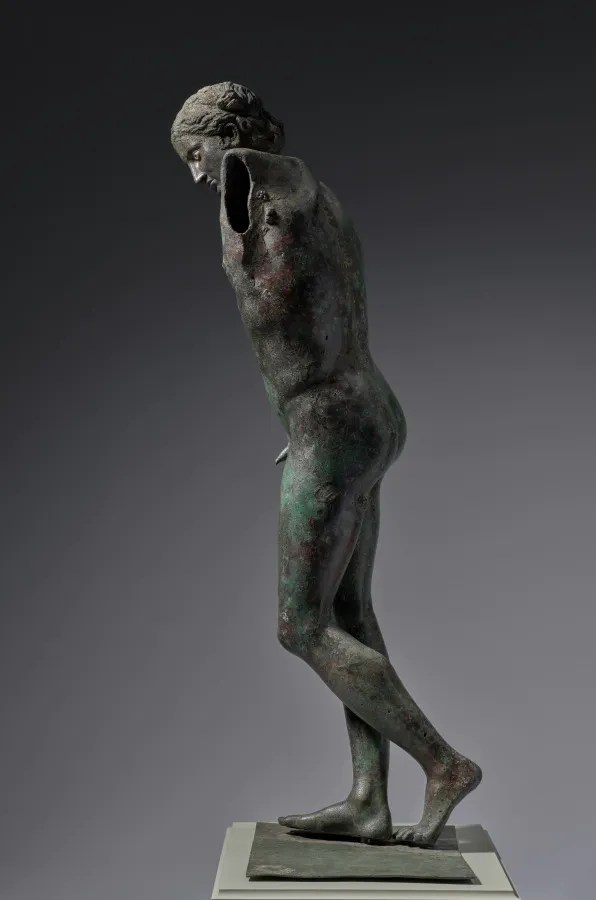
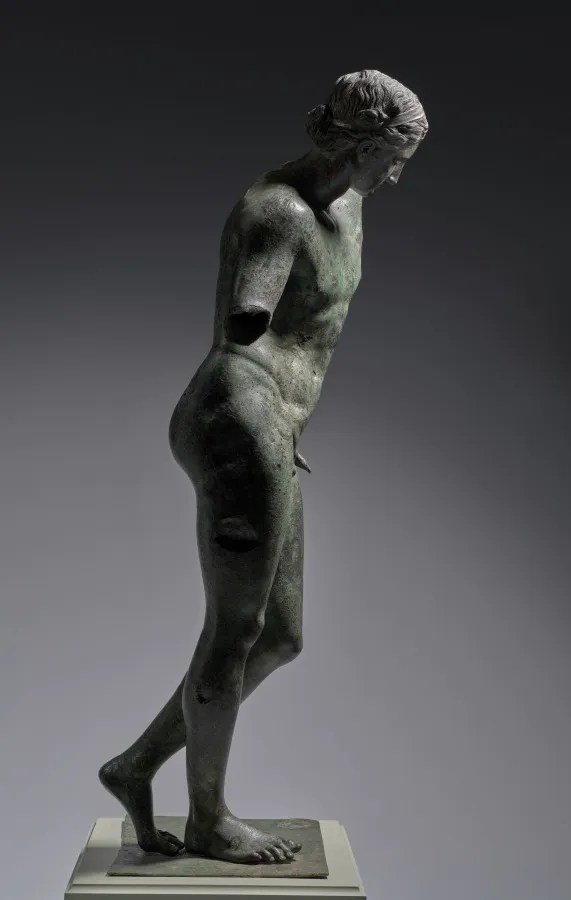
This bronze figure of Apollo is one of the most important surviving sculptures connected to Praxiteles and to the tradition of large-scale Greek bronze casting. Dated to about 350 BC, it presents the god not in triumphant action, but in a poised, youthful stillness that gives the work much of its power. The statue has long attracted attention not only for its quality and rarity, but also for the uncertainty surrounding its exact subject: whether it should be linked to the well-known Apollo Sauroktonos type or understood instead in relation to Apollo’s killing of the Python.
A Bronze from the Age of Praxiteles
The sculpture belongs to the middle of the 4th century BC and is attributed to Praxiteles, one of the most admired sculptors of the Classical Greek world. Praxiteles was especially known for giving divine figures an unusually graceful, humanized presence, and that quality is central here. Apollo appears as an idealized youth, relaxed yet alert, embodying the elegant physical type for which the sculptor became famous. The Cleveland bronze is particularly important because it is the only surviving large-scale bronze example associated with this sculptural tradition, making it a key work for the study of both Praxitelean design and ancient bronze statuary.
Between the Lizard and the Python
Much of the sculpture’s fascination lies in the question of what, or whom, Apollo was originally confronting. Ancient testimony from Pliny the Elder describes a statue by Praxiteles of Apollo aiming at a lizard, giving rise to the long-standing identification with the Apollo Sauroktonos, or Lizard-Slayer. Yet the Cleveland figure has also prompted another interpretation. Some scholars have argued that the lost creature may have been not a lizard, but the Python, the serpent Apollo slew at Delphi.
That uncertainty matters because it changes the tone of the work. If linked to the Sauroktonos type, the statue belongs to a more playful and refined mode of divine imagery. If understood as Apollo the Python-Slayer, it takes on a more explicitly mythic and religious character. The ambiguity has helped keep the sculpture at the center of scholarly debate.
Apollo as Ideal Youth
Whatever its exact narrative identity, the statue clearly draws on the Greek image of Apollo as a youthful and perfectly formed god. In Greek art, Apollo often appears as an embodiment of beauty, balance, and controlled energy, and those qualities are strongly present here. The figure’s hair, proportions, and calm bearing all contribute to that ideal. At the same time, the sculpture’s refined details, including copper inlays for the lips and nipples and the careful rendering of fingernails, show how much attention Greek artists gave to making bronze figures feel vivid and alive.
The statue therefore carries both artistic and cultural weight. It is a representation of Apollo, but it is also a statement about Greek ideals of youth, divinity, and bodily perfection.
Bronze, Inlay, and Missing Elements
The sculpture is made of bronze, with additional copper and stone inlay. It stands 150 cm high (59 inches), on a base measuring 47.3 × 40.7 cm (18 1/2 × 16 inches). The surviving surface preserves a high level of detail, especially in the hair and smaller anatomical features. At the same time, important parts are now lost, including the left arm and the tree support, and the flat bronze base may be a later addition. These losses affect how the statue is read, especially since the missing elements were likely crucial to its original action and meaning.
Survival, Debate, and Preservation
Although the exact circumstances of the sculpture’s discovery are unclear, it eventually entered the collection of the Cleveland Museum of Art, where it has become one of the museum’s most important classical works. Over time, the statue has required careful conservation, both because of its age and because several elements survive only in incomplete form. Even so, the remaining figure retains enough of its original richness to make it an exceptional source for the study of ancient Greek sculpture, bronze technique, and the enduring complexity of Praxiteles’ legacy.
-

Apollo the Python Slayer – Museum Replica
Price range: €94,00 through €125,00


