
| Date | c.1200 CE |
| Place of origin | Preah Khan, Cambodia |
| Culture/Period | Khmer/Angkor Period |
| Material/Technique | Sandstone |
| Dimensions | 71.3 cm (28 1/16 in.) in height, 50 cm (19 11/16 in.) in width, and 47 cm (18 1/2 in.) in depth |
| Current location | The Cleveland museum of art, USA |
| Licence | Colossal Head of a Deva · by Cleveland Museum of Art · CC BY 4.0 |
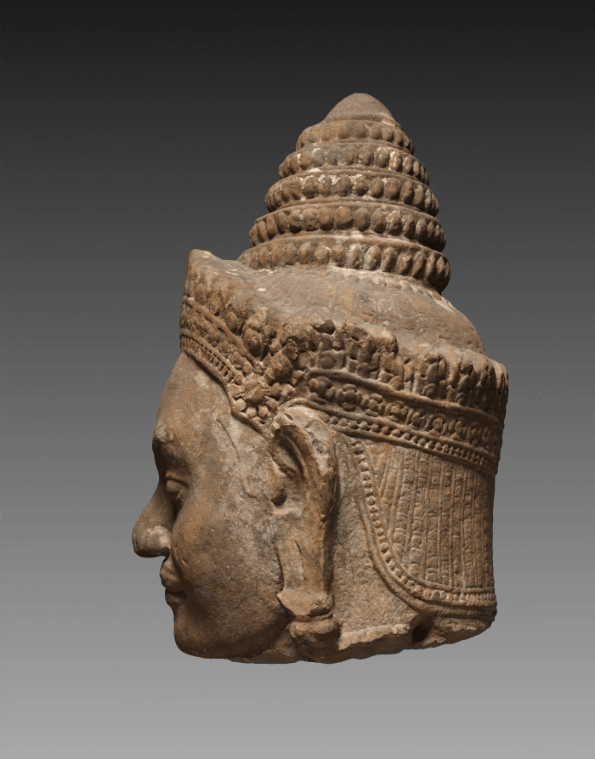
The face still carries a calm, almost unshaken authority, even in fragmentary form. Rising from the massive features is a tall, elaborate crown whose layered lotus finial gives the head an unmistakable sacred presence. This colossal deva head, carved for the temple world of Angkor, was never meant to be seen as an isolated portrait. It once belonged to a larger divine image, part of an architectural and ritual setting where stone figures helped transform the temple into a living vision of cosmic order.
A Monumental Image from Angkor
This sculpture was created around 1200 in the Angkor region of Cambodia, most likely for the great temple complex of Preah Khan during the reign of Jayavarman VII. That was one of the most ambitious and artistically fertile periods in Khmer history. Angkor was then the center of a vast empire, and its temples were not only places of worship but statements of royal power, spiritual legitimacy, and artistic mastery. Preah Khan itself was a particularly rich site, shaped by the religious complexity of the age, when older Hindu imagery continued to coexist with, and sometimes merge into, the expanding influence of Mahayana Buddhism. This deva head belongs to that moment of transition and synthesis.
The Deva and the Sacred World of the Temple
As a deva, the figure represents a benevolent divine being from Hindu cosmology, one associated with celestial order, protection, and the maintenance of the universe. In Khmer temple art, such beings were not incidental decoration. They helped populate the sacred environment with presences that made the temple feel cosmically inhabited. The likely connection to the myth of the Churning of the Ocean of Milk is especially significant. In that great story, the devas struggle alongside the asuras to obtain the nectar of immortality, and the drama of creation, danger, sacrifice, and divine triumph unfolds on a universal scale. A figure like this would therefore have carried meanings far beyond individual identity. It stood for divine participation in the cosmic balance on which kingship, ritual, and the world itself depended.
Crown, Lotus, and Divine Authority
One of the most striking features of the sculpture is the crown. The tall conical tiara, with its floral diadem and five-tiered lotus finial, gives the figure a strongly hierarchical and sacred character. In both Hindu and Buddhist symbolism, the lotus carries profound associations with purity, spiritual emergence, and transcendence. Here it also intensifies the figure’s supernatural authority. The crown does not simply identify rank; it lifts the head upward into a more symbolic register, making the deva appear as a being poised between earthly monumentality and divine refinement.
Sandstone and Khmer Craftsmanship
The head is carved from sandstone and measures 71.3 cm in height, 50 cm in width, and 47 cm in depth, or 28 1/16 × 19 11/16 × 18 1/2 inches. Even as a fragment, it retains a monumental force. Khmer sculptors were masters of sandstone carving, able to combine broad, powerful volumes with finely controlled details, especially in headdresses, jewelry, and facial modeling. The surfaces here show that balance clearly. The expression remains serene and controlled, while the crown is articulated with precision and ornamental richness. That combination of calm face and elaborate headdress is one of the hallmarks of mature Angkorian sculpture.
From Preah Khan to Cleveland
The head originally formed part of a larger deva statue at Preah Khan, probably positioned in an architectural or ritual context where it would have contributed to the temple’s sacred atmosphere. Its later history is less certain, as with many Khmer sculptures that left Cambodia during the colonial era or amid later upheavals. It eventually entered the collection of the Cleveland Museum of Art, where it remains one of the museum’s most powerful examples of Khmer art.



-

Colossal head of a Deva – Museum replica
Price range: €105,00 through €291,00


