
| Date | 400s-500s CE |
| Place of origin | Iran |
| Culture/Period | Sasanian empire |
| Material/Technique | Gilt silver |
| Dimensions | 4.6 cm in height and 20.8 cm in diameter (1 13/16 x 8 3/16 in.) |
| Current location | The Cleveland museum of art, USA |
| Licence | CC0 |
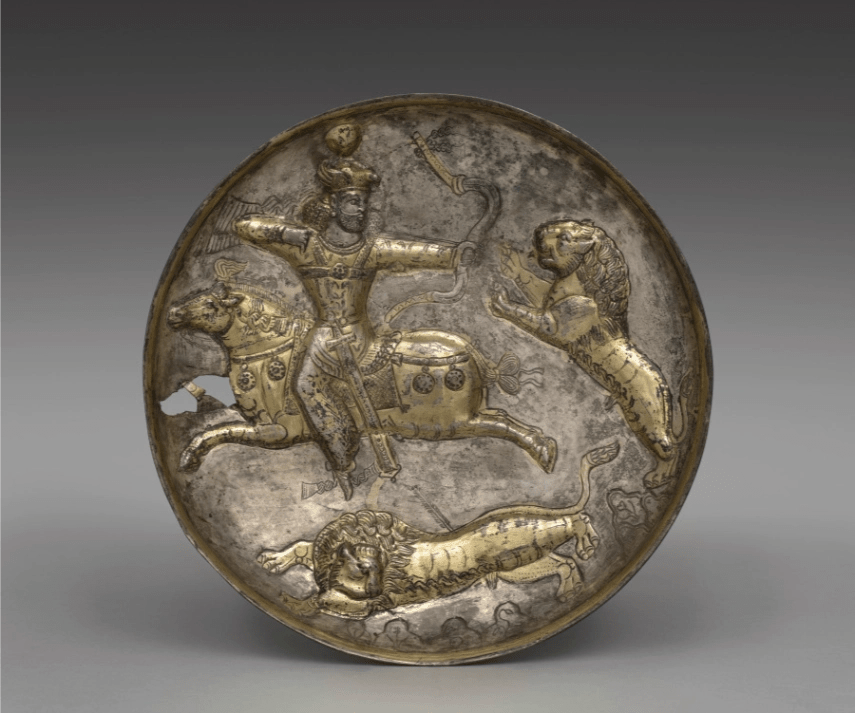
Horse and rider surge across the silver surface with concentrated force, the king turning in the midst of the hunt as lions close around him. Though small in scale, the dish carries the drama of royal power made visible: speed, danger, mastery, and the charged symbolism of the lion hunt. In Sasanian Persia, such an image was never simply about sport. It declared the ruler’s strength, his right to govern, and his ability to hold order against the forces of chaos.
A Royal Image from Sasanian Iran
This silver-gilt dish was made in Iran during the Sasanian Empire, most likely in the 5th or 6th century CE, when the dynasty stood as one of the great powers of the ancient world. The Sasanians ruled from 224 to 651 CE and cultivated a court culture of exceptional refinement, in which metalwork played an important role in expressing rank, wealth, and royal ideology. The king shown here is usually identified as Hormizd II, who ruled from 303 to 309 CE, although the dish itself was made long after his lifetime. That distance in time suggests the object was not a direct portrait from his reign, but a later evocation of royal memory, perhaps commissioned in a moment when recalling an earlier ruler served political or ceremonial aims.
The Lion Hunt as Royal Theater
The hunt was one of the most charged images in Sasanian art, and the lion hunt above all carried a meaning beyond the literal act. In Persian royal culture, the king’s conquest of dangerous animals stood for his power to protect the realm and maintain cosmic order. This idea drew on older Near Eastern traditions, including Assyrian royal hunting imagery, but in the Sasanian world it took on a distinctly Iranian inflection, shaped by ideas of kingship and Zoroastrian order. To defeat the lion was to demonstrate not merely physical bravery, but the ruler’s fitness to stand between civilization and disorder.
That gives the dish its true force. The scene is compact and elegant, yet it communicates an entire political theology. Hunting becomes a form of royal theater in which power, divine favor, and legitimacy are all performed at once.
Hormizd, Memory, and Dynastic Meaning
The king’s identity rests above all in his crown, one of the most distinctive features of Sasanian royal imagery. Here, the ruler wears an eagle-shaped crown topped by a jeweled korymbos, the fabric-covered mass of hair or headdress that rises above many Sasanian crowns. Such crowns were highly individualized, allowing rulers to be recognized through silhouette and ornament alone. If this dish was indeed made centuries after Hormizd II’s death, its imagery may have functioned as a deliberate act of dynastic recall, preserving or reviving a royal image at a time when the authority of later kings needed strengthening. In that sense, the dish may have served not only as a luxury object, but as a politically resonant one.
Silver, Gilding, and Courtly Refinement
The dish is made of silver with gilt accents and measures 4.6 cm in height and 20.8 cm in diameter, or 1 13/16 × 8 3/16 inches. Its shallow form and modest size suggest that it was not an everyday vessel, but an object intended for elite use, perhaps in ceremonial display or as a courtly treasure. The relief is handled with remarkable clarity. Horse, rider, lions, and royal regalia are all compressed into a tightly ordered composition, while the gilding adds emphasis and splendor to the scene. The king’s clothing, harness, and weaponry are rendered with enough detail to underscore both his status and the high technical skill of the metalworkers who produced the piece. Like much Sasanian silver, it balances elegance with force.
From Ancient Persia to Cleveland
The dish’s early history is uncertain, as is often the case with Sasanian metalwork, much of which passed through centuries of dispersal, trade, and undocumented collecting. It was likely made in a royal or elite workshop, perhaps in a major center such as Ctesiphon or Susa, before eventually entering the modern art market. Today it is in the collection of the Cleveland Museum of Art, where it survives as a vivid expression of Sasanian kingship, craftsmanship, and imperial imagination.


-

Dish with King Hormizd II – Museum replica
Price range: €94,00 through €476,00


