
| Date | c.1750 CE |
| Place of origin | Paris, France |
| Culture/Period | France, Enlightenment |
| Material/Technique | Gilt bronze |
| Dimensions | 72.4 cm (28 1/2 in.) in height, 49.3 cm (19 7/16 in.) in width, and 39.7 cm (15 5/8 in.) in depth |
| Current location | The Cleveland museum of art, USA |
| Licence | CC0 |
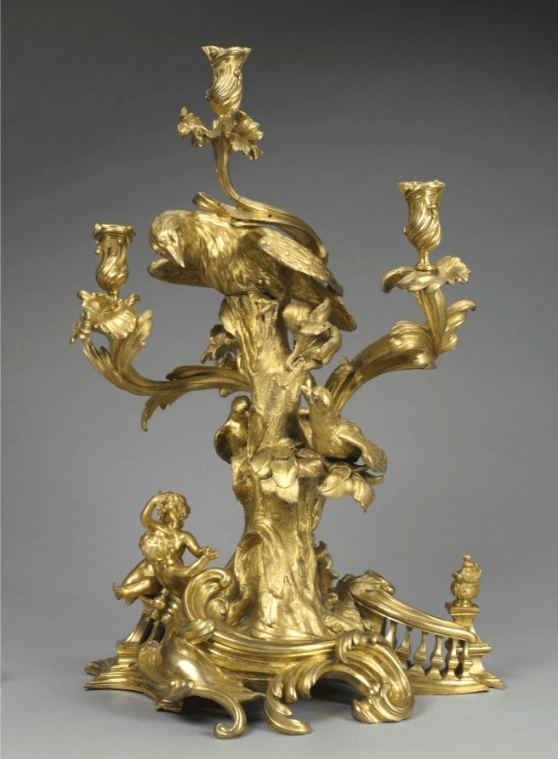
Its branches seem almost to grow rather than merely extend, rising in curves and flourishes that turn candlelight into ornament. Even unlit, the candelabrum possesses the radiance of something made to animate a room—to shimmer, reflect, and command attention within an interior shaped by luxury and display. In this gilt-bronze work attributed to Jean Joseph de Saint-Germain, function and fantasy meet, creating an object that is at once practical, theatrical, and deeply expressive of 18th-century French taste.
A Parisian Work from the Mid-18th Century
This candelabrum was made around 1750 in Paris, at a moment when French decorative art was at its most refined and inventive. The reign of Louis XV fostered a culture in which furniture, silver, bronzes, and interior ornament all became vehicles for elegance and social distinction. Parisian bronziers played a central role in that world, supplying aristocratic patrons with objects that transformed interiors into environments of cultivated pleasure. The candelabrum is attributed to Jean Joseph de Saint-Germain, one of the most accomplished bronziers of his generation, whose career flourished after he became a master in 1748. If the attribution is correct, the piece belongs to the height of his early success, when Rococo exuberance still dominated but new ideals of order were beginning to appear.
Rococo Grace and Emerging Restraint
What makes the object especially fascinating is its position between styles. The curling, plant-like arms and fluid asymmetry are unmistakably Rococo, with their delight in movement, growth, and ornament derived from nature. Yet the overall balance of the composition also suggests the first pull toward Neoclassicism, the style that would soon reshape French taste under the influence of archaeological discovery and Enlightenment thought. This candelabrum stands precisely at that transition. It still revels in Rococo liveliness, but its structure is not purely capricious. There is an underlying coherence that hints at a new desire for proportion and clarity.
Light, Luxury, and Aristocratic Interiors
In an 18th-century interior, such an object would have done far more than hold candles. It would have shaped the mood of a room. The gilt bronze would catch and multiply the glow of flames, turning light itself into part of the decoration. In that sense, candelabra like this were integral to the visual life of salons, reception rooms, and private apartments, where conversation, display, and ceremony all took place under carefully managed illumination. They were signs of wealth, certainly, but also of taste. To own and display such a work was to participate in a culture that valued refinement, artistic invention, and the fusion of utility with beauty.
The association with Saint-Germain strengthens that impression. He was not only a skilled craftsman, but a figure of real standing in his field, involved in defending the rights and status of Parisian bronziers. His workshop produced objects for elite clients, and works of this kind would have belonged to the visual language of aristocratic life at its most polished.
Gilt Bronze and Technical Precision
The candelabrum is made of gilt bronze and measures 72.4 cm in height, 49.3 cm in width, and 39.7 cm in depth, or 28 1/2 × 19 7/16 × 15 5/8 inches. It was likely cast in sections, probably using the lost-wax method, and then finished with mercury gilding, the labor-intensive and hazardous process that gave French bronzes of this period their extraordinary golden surface. The details required exceptional skill: each arm had to be modeled with fluidity and precision, the candle sockets integrated into the decorative logic of the whole, and the gilding applied evenly enough to heighten every contour. The result is an object whose technical mastery remains inseparable from its visual effect.
From an Aristocratic Setting to Cleveland
The candelabrum’s early ownership is not recorded, which is not unusual for decorative arts of this period, but it was almost certainly made for a wealthy French patron and once formed part of an aristocratic interior. By 1946 it had entered the collection of the Cleveland Museum of Art through the John L. Severance Fund. Today it survives not only as a beautiful object, but as a vivid reminder of how 18th-century France turned even the practical necessities of light into works of sculptural imagination.

-

Gilt candelabrum – Museum replica
Price range: €108,00 through €386,00


