
| Date | Ca. 1600 BCE |
| Place of origin | Northern Syria |
| Culture/Period | Hittite Empire |
| Material/Technique | Basalt |
| Dimensions | 87.6 cm (34 1/2 in.) tall |
| Current location | The Cleveland Museum of Art, USA |
| Licence | CC0 |
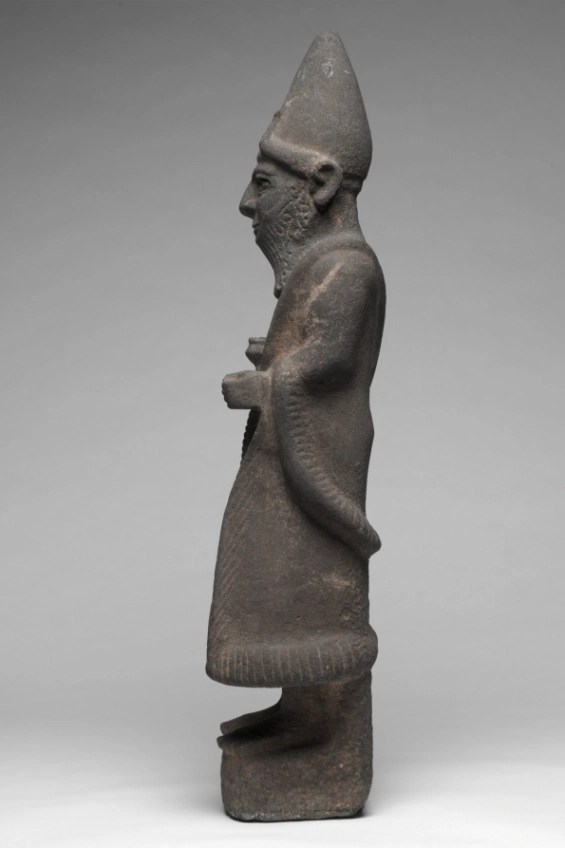
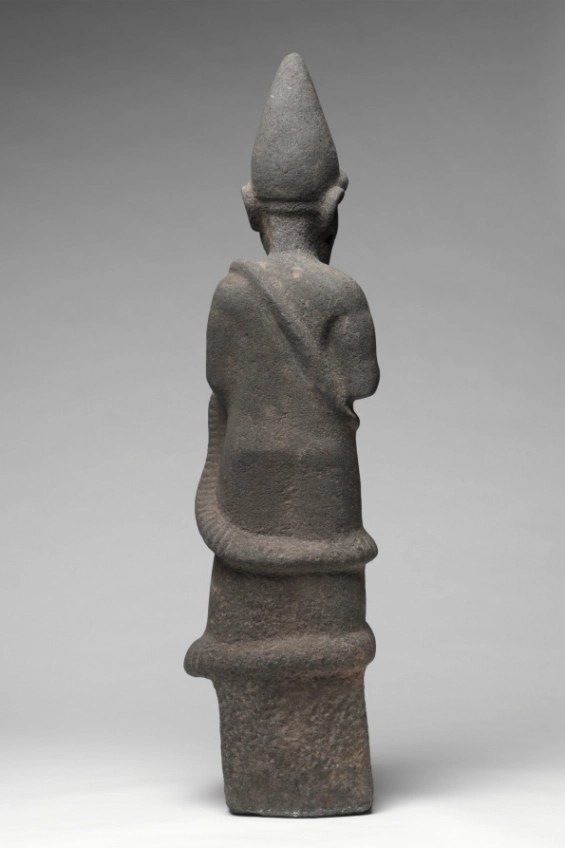
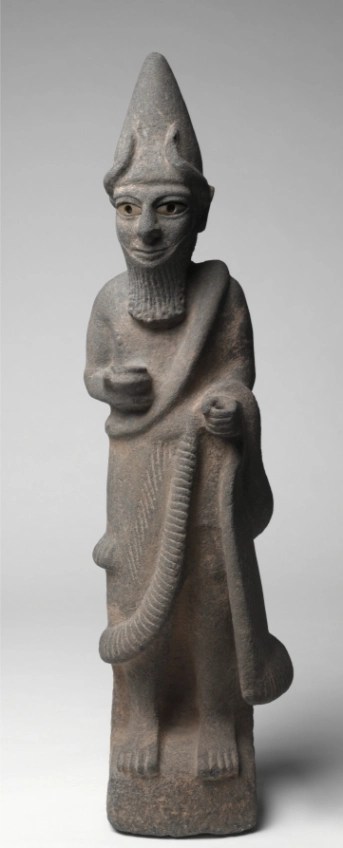
With its horned crown, false beard, and rare bone-inlaid eyes, this basalt figure has an immediate and unusual force. Identified either as a priest king or as a deity, it stands at the intersection of royal authority and divine power, holding a bowl in one hand while the other once grasped an object now lost. Created around 1600 BCE in North Syria, the sculpture offers a compelling glimpse into the visual world of the Hittites, where political power, ritual identity, and monumental stone carving were closely bound together.
Basalt and the World of the Hittites
The sculpture was carved from fine-grained basalt, a volcanic stone formed through the rapid cooling of magnesium- and iron-rich lava, and one of the most common igneous rocks on earth. It was made within the Hittite sphere of North Syria around 1600 BCE, during the early centuries of a civilization that would become one of the great powers of Bronze Age Anatolia and the Near East. The Hittites, an Indo-European people who entered Anatolia in the 3rd millennium BCE, established their capital at Hattusa and expanded their influence widely, drawing in traditions from Anatolia, Syria, and Mesopotamia. This figure belongs to that early period of Hittite artistic development, when large-scale stone sculpture already served as a potent vehicle for authority, ceremony, and belief.
Damage, Survival, and a Silent History
One of the most striking details of the figure is its eyes. The left eye preserves an original bone inlay, while the right has been restored in modern times, creating a small but powerful reminder of the object’s long and damaged history. That contrast hints at centuries of loss, whether through violence, weathering, reuse, or burial. One can imagine such a figure once standing in a temple or palace setting, where it would have presided over acts of devotion, ceremony, or royal display. Its survival across more than three millennia, despite missing elements such as the object once held in the left hand, gives it an added sense of endurance.
Priest-King or Deity
The sculpture’s identity remains uncertain, and that ambiguity is part of its fascination. It may represent a god, or a priest-king understood as the earthly deputy of the storm god, one of the central divinities in Hittite religion. The horned conical crown is especially important, since horns in the ancient Near East often marked divinity or elevated authority. The false beard and long robe further emphasize its ceremonial or regal character, while the bowl in the right hand suggests a ritual role, perhaps tied to offering or libation. In this fusion of divine and political imagery, the sculpture reflects the Hittites’ layered religious world, where local Anatolian traditions were joined with Syrian and Hurrian influences in a complex and tolerant polytheism.
Carving in Basalt
Carved from basalt, the figure demonstrates a high level of technical control over a hard and durable material. Basalt’s dark, dense surface gives the sculpture a weight and solidity that suit its imposing character, while the carefully shaped crown, robe, beard, and bowl reveal close attention to detail. The surviving eye inlay adds a vivid and almost unsettling lifelike quality, especially against the stone’s uniform texture. Measuring 87.6 cm in height (34 1/2 in.), the sculpture is large enough to command presence while still retaining an intimacy of workmanship. The now-missing object in the left hand, perhaps a staff or sword, would once have completed the figure’s symbolic program.
From North Syria to the Museum
The sculpture originated in North Syria, a region closely connected to Hittite power and culture during the Bronze Age. Its early history is unknown, as is often the case with ancient works removed from their original context, but it eventually entered the collection of the Cleveland Museum of Art. Its modern rediscovery belongs to the broader recovery of Hittite civilization through excavation and scholarship, especially from the 19th century onward, when finds from sites such as Hattusa and Kültepe began to reshape modern understanding of this once-lost world.
A Rare Witness to Hittite Power
Today, the Priest-King or Deity remains a rare and important witness to Hittite visual culture and to the wider Bronze Age Near East. Its significance lies not only in its scale and craftsmanship, but also in the questions it continues to raise. Is it a god, a ruler, or a figure deliberately poised between the two? What did it originally hold, and where exactly did it stand? As research in Hittite studies continues, the sculpture remains a powerful and tangible link to a civilization that helped shape the ancient eastern Mediterranean.


-

Priest-King or Deity – Museum Replica
Price range: €94,00 through €228,00


