
| Date | c.1850-1900s CE |
| Place of origin | Korea |
| Culture/Period | Joseon dynasty |
| Material/Technique | Gilded paper, metal wire, and black silk. |
| Dimensions | 24.2 cm in height, 26.7 cm in width, and 17.8 cm in depth (9 1/2 × 10 1/2 × 7 in.) |
| Current location | The Cleveland museum of art, USA |
| Licence | CC0 |
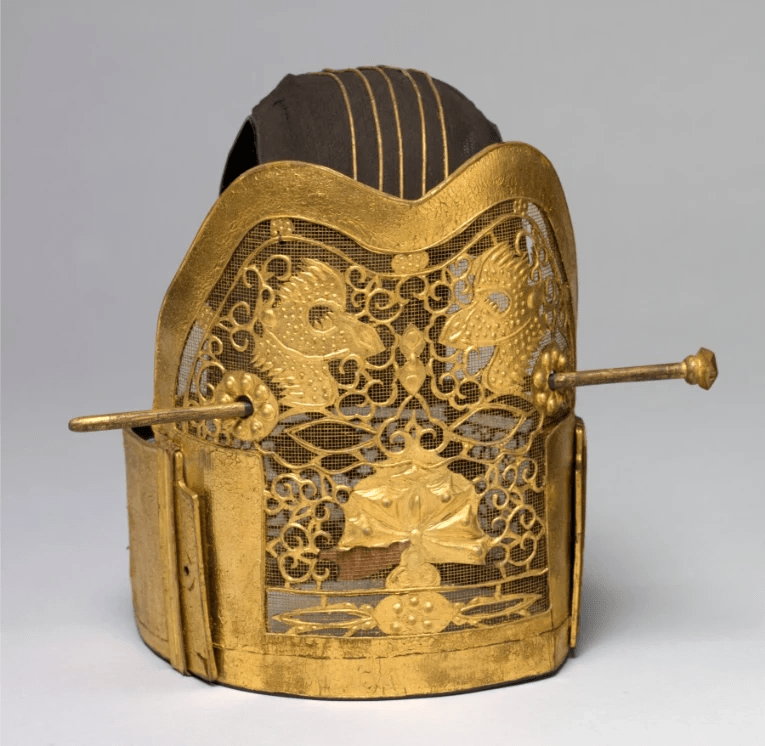
Delicate in material yet commanding in presence, this Joseon court crown turns ceremony into visible order. Its black silk surface, gilded details, and carefully balanced form were not designed simply to impress, but to embody authority, restraint, and ritual legitimacy. Worn as part of the most formal court dress, it belongs to a world in which clothing did not merely reflect status, but helped enact the moral and cosmic structure on which the dynasty understood itself to rest.
A Crown from the Final Joseon Court
This crown was made in the late 19th or early 20th century, during the final decades of the Joseon dynasty, a period when Korea’s court culture still maintained highly codified ceremonial traditions even as the political world around it was rapidly changing. It formed part of the myeonbok, the most formal ceremonial costume worn by monarchs and high-ranking officials during major state rites. In Joseon society, shaped deeply by Confucian ideals, dress was never neutral. Every material, color, and structural element carried meaning, signaling rank, virtue, and proper alignment within a carefully ordered hierarchy. A crown such as this was therefore not simply an accessory, but a central component of ritual identity.
Ceremony, Ancestors, and Sacred Governance
The crown was used in the context of major court ceremonies, especially those tied to kingship, ancestral devotion, and state legitimacy. Among the most important of these were the Jongmyo Jerye rites performed at the Jongmyo shrine in Seoul, where deceased kings and queens were honored through elaborate ritual observances. In such settings, garments and regalia helped create the atmosphere of solemn continuity that linked the living court to its dynastic past. Crowns of this type also belonged to the broader ceremonial culture surrounding Confucian academies such as Sungkyunkwan, where governance, scholarship, and ritual reverence were understood as deeply interconnected. The object therefore belongs not only to court dress, but to a larger system in which political authority was inseparable from moral and ceremonial performance.
Symbol, Structure, and Moral Authority
What gives this crown its significance is the way its form translates abstract ideas into visible shape. It was not made merely to be beautiful, though its elegance is unmistakable. It was designed to express a particular conception of rulership and social order. The black silk conveys gravity and restraint, while the gilded elements signal dignity and elevated status. Even the horizontal rod, one of the crown’s most distinctive features, had symbolic force, suggesting balance, stability, and the wearer’s role as a mediator within a larger cosmic order. In the Joseon court, where proper ritual conduct was seen as a reflection of ethical governance, such symbolism was not ornamental in a secondary sense. It was central to the object’s purpose.
Gilded Paper, Silk, and Lightness of Construction
The crown is made of gilded paper, metal wire, and black silk, and measures 24.2 cm in height, 26.7 cm in width, and 17.8 cm in depth, or 9 1/2 × 10 1/2 × 7 inches. Its materials are especially revealing. Gilded paper provided the visual richness of gold without the weight that solid metal would have imposed, while the inner wire structure gave the object firmness and stability. The black silk overlay unifies the whole and gives it the sober finish appropriate to high ritual use. The craftsmanship lies not only in surface refinement, but in the careful balance between opulence and wearability. It is an object made to hold its form over long ceremonies while preserving the dignity and composure expected of the wearer.
In the Cleveland Museum of Art
This crown is now in the collection of the Cleveland Museum of Art, where it survives together with a broader group of Joseon ceremonial garments and accessories. In that setting, it offers a rare and vivid insight into the visual culture of the late Korean court, preserving not just an object of dress, but a whole ceremonial world built on hierarchy, continuity, and ritual meaning.


-

Royal crown – Museum replica
Price range: €103,00 through €597,00


