
| Date | c. 1000 CE |
| Place of origin | Tamil Nadu, India |
| Culture/Period | India/Chola Period |
| Material/Technique | Bronze |
| Dimensions | 76.5 x 45 cm (30 1/8 x 17 11/16 in.), with hollow base 26 x 25 cm (10 1/4 x 9 13/16 in.) |
| Current location | The Cleveland museum of art, USA |
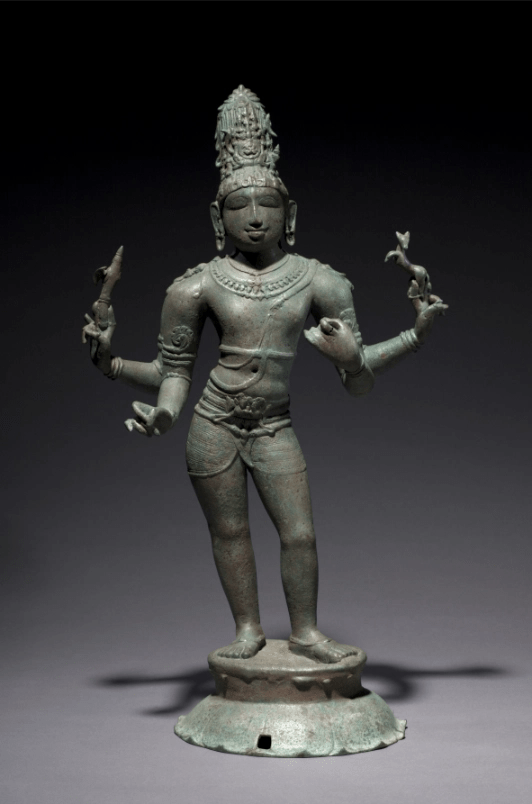
The bronze sculpture of Shiva as Lord of Music, crafted around 1000 CE during the Chola period in Tamil Nadu, South India, is a masterful representation of the Hindu deity Shiva in his serene and beneficent form as the divine patron of music. Housed in the Cleveland Museum of Art, this work exemplifies the Chola dynasty’s artistic and spiritual sophistication, capturing Shiva’s role as a cosmic harmonizer through music. The sculpture portrays Shiva with four arms, his lower hands positioned to play a now-missing vina (a stringed instrument), while his upper hands hold an axe and a rearing antelope, symbolizing his divine attributes.
Originating from the Chola dynasty (900–13th century), a golden era of South Indian art and religion, this bronze was created in Tamil Nadu, a hub of Shaivite devotion. The Cholas, known for their maritime trade and patronage of temples like the Brihadisvara Temple in Thanjavur, produced such bronzes for ritual worship and processions. Crafted around 1000 CE using the lost-wax technique, this sculpture reflects the dynasty’s technical mastery and devotion to Shiva. It was likely commissioned by royalty or wealthy devotees for a temple, embodying the Chola synthesis of art, music, and spirituality.
Chola bronzes are steeped in stories of divine intervention and temple rituals. Legends describe Shiva manifesting in temple sanctums during musical performances, with the vina’s melodies believed to invoke his presence. During Chola festivals, bronzes like this one were carried in processions, accompanied by Tevaram hymns sung to vina accompaniment, creating a transcendent atmosphere. The missing vina in this sculpture may spark speculation about its loss—possibly due to ritual wear, looting, or separate casting—adding to its mystique.
Within its cultural context, the sculpture embodies the Chola reverence for Shiva as the supreme deity in Shaiva Siddhanta philosophy. Music, represented by the vina, was integral to temple worship, symbolizing cosmic harmony and the nada (cosmic sound) underlying creation. The axe signifies Shiva’s power to destroy ignorance, while the antelope represents mastery over the mind and knowledge of the Vedas, linking music to sacred learning. Artistically, the sculpture’s fluid lines and serene expression reflect Chola ideals of divine beauty and balance, influencing Southeast Asian art through trade. Its processional function underscores its role in communal worship, bridging the divine and human realms.
The sculpture is cast in bronze using the lost-wax technique, a Chola specialty that allowed for intricate detailing. It measures 76.5 x 45 cm (30 1/8 x 17 11/16 in.), with a hollow base of 26 x 25 cm (10 1/4 x 9 13/16 in.) designed for processional poles. The four-armed figure stands in a balanced pose, with delicate fingers poised to play the missing vina, likely made of wood or metal and attached separately. The axe and antelope are finely modeled, showcasing the Cholas’ skill in capturing movement and texture. The bronze’s surface, polished for ritual use, bears a patina typical of ancient bronzes.
The sculpture’s early provenance is unclear, as is common with Chola bronzes, which were often preserved in temple treasuries. It likely remained in a Tamil Nadu temple until the colonial period, when many bronzes were looted or sold. By the 20th century, it entered the collection of the Cleveland Museum of Art, where it is displayed as a highlight of South Asian art.


-

Shiva as Lord of Music – Museum replica
Price range: €94,00 through €288,00


