
| Date | c. 900 CE |
| Place of origin | Kashmir, India |
| Culture/Period | India |
| Material/Technique | Brass with silver and copper inlays |
| Dimensions | 98.1 cm (38 5/8 in.) in height, with a base of 28.2 cm (11 1/8 in.) |
| Current location | The Cleveland museum of art, USA |
| Licence | CC0 |
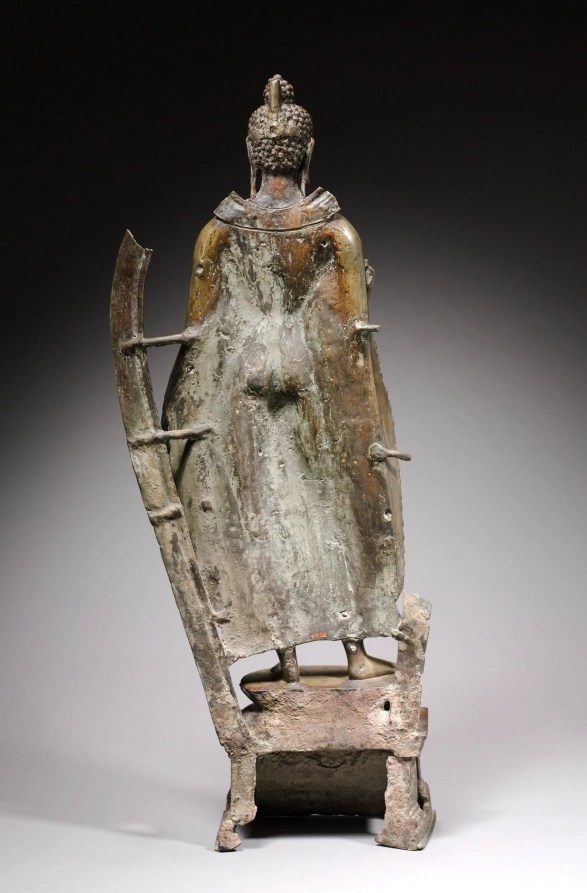
The figure seems to move even in stillness. One foot advances from the lotus base, the robe is lightly gathered in one hand, and the body carries an almost living poise, as if the Buddha were stepping toward the worshipper rather than remaining distant in transcendence. In this Kashmiri bronze, spiritual presence is made immediate: elegant, calm, and quietly powerful.
A Kashmiri Masterpiece from Around 900 CE
This Standing Buddha was created in Kashmir around the late 10th to early 11th century, during a period when the region was one of the great centers of Buddhist art in the Himalayas. At that time, Kashmir was renowned for its metal sculpture, producing refined sacred images that combined Indian Buddhist traditions with local and Central Asian influences. The work belongs to the final flourishing of Buddhist Kashmir, before the religion’s decline there in the centuries that followed. It stands as a product of a highly sophisticated artistic culture in which bronze images were not only made for visual admiration, but for sustained ritual life.
From Kashmir to Tibet
One of the most important details about this sculpture is the Tibetan inscription on the pedestal, which links it to Nagaraja, a royal monk active around 998–1026 and the son of the Western Tibetan king Yeshe Ö. That connection places the image within the “Second Diffusion” of Buddhism in Tibet, when teachers, texts, and works of art from Kashmir and northern India played a decisive role in shaping Tibetan Buddhist culture. This Buddha was therefore not simply a Kashmiri object that survived; it was part of a larger movement of ideas, devotion, and artistic exchange across the Himalayan world. In Tibet, it would have carried both spiritual prestige and cultural authority.
A Buddha Who Approaches the Human World
What makes the sculpture especially compelling is its pose. Rather than standing rigidly frontal, the Buddha appears to step slightly forward from the lotus pedestal. That subtle movement transforms the image. It suggests a Buddha who is not withdrawn into remote transcendence, but one who comes toward the world in compassion. The gesture of fearlessness, together with the forward motion, creates an image of reassurance and accessibility. This is very much in keeping with Mahayana Buddhist ideals, in which the enlightened being remains engaged with suffering humanity rather than removed from it.
The repeated ritual bathing that the image seems to have undergone, suggested by the smooth wear across the surface, deepens that sense of lived religious presence. This was not an object admired from a distance. It was touched, washed, and venerated over time, its sacred force continually renewed through worship.
Form, Material, and Kashmiri Elegance
The sculpture is made of brass with silver and copper inlay and stands 98.1 cm high, or 38 5/8 inches, with a base measuring 28.2 cm, or 11 1/8 inches. The inlays enrich features such as the eyes, the urna, and details of the robe, adding both refinement and spiritual emphasis. The body is slender and athletic, with a narrow waist and softly modeled torso, reflecting a specifically Kashmiri ideal of grace and contained vitality. The lotus pedestal is also finely worked, reinforcing the symbolism of purity and spiritual emergence. The combination of smooth surfaces and delicate inlaid detail shows the exceptional technical skill of Kashmiri metalworkers, whose sculptures would become highly influential in Tibet and neighboring Himalayan regions.
A Sacred Object with a Long Journey
The sculpture was likely made originally for a monastery or temple in Kashmir, then later entered the possession of Nagaraja in western Tibet. From there it may have been housed in a monastery in regions such as Guge or Ngari, where Kashmiri artistic models were especially valued. Its eventual arrival in the Cleveland Museum of Art reflects a much later history of collecting, but the object still carries clear traces of its earlier life: a sacred image shaped in Kashmir, treasured in Tibet, and preserved as one of the finest surviving examples of Buddhist bronze sculpture from the western Himalayas.



-

Standing Buddha – Museum Replica
Price range: €94,00 through €423,00


