
| Date | 2144–2124 BCE |
| Place of origin | Girsu, Southern Iraq |
| Culture/Period | Mesopotamia |
| Material/Technique | Dolerite |
| Dimensions | 126 cm (49 5/8 in.) in height, 55 cm (21 5/8 in.) in width, and 36 cm (14 3/16 in.) in depth |
| Current location | The Cleveland Museum of Art, USA |
| Licence | CC0 |
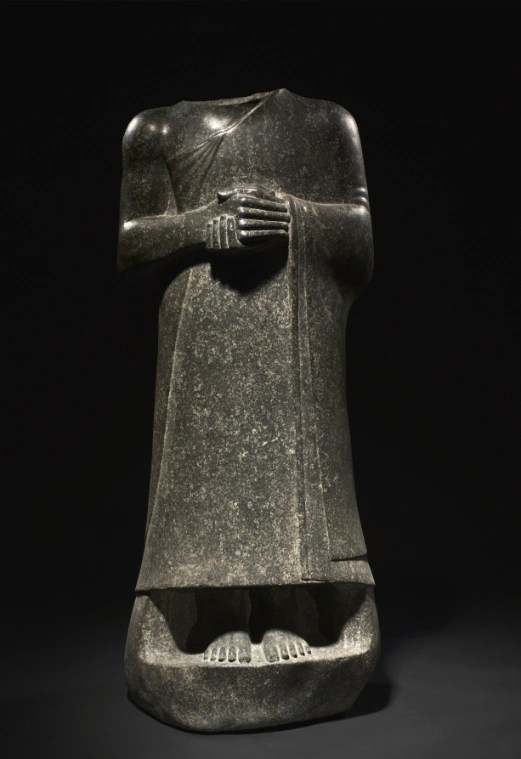
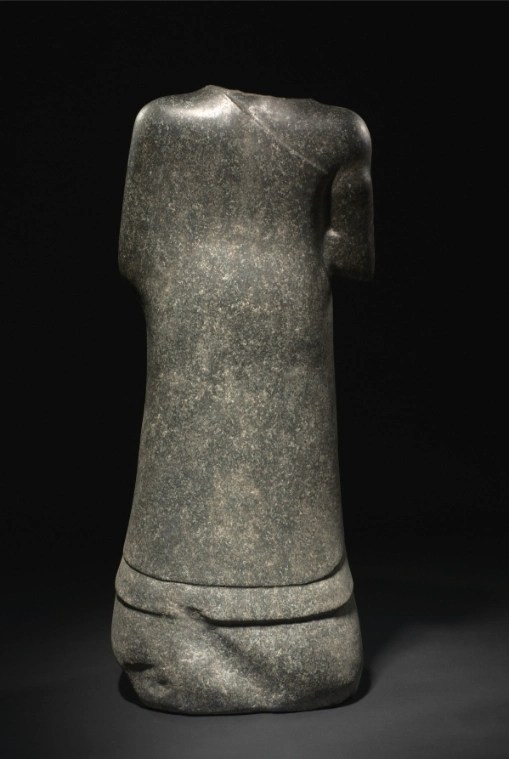
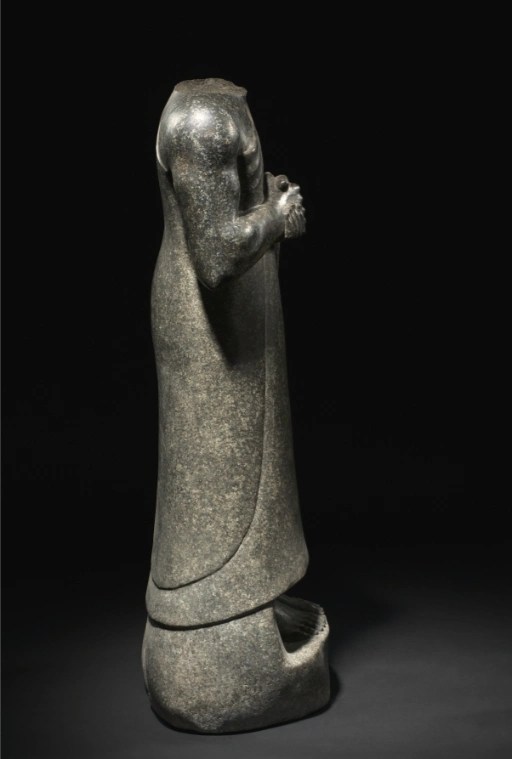
Even without its head, this statue of Gudea retains a powerful sense of presence. Carved in dark dolerite and marked by the ruler’s characteristic clasped hands, it embodies the piety, authority, and artistic ambition of Neo-Sumerian Mesopotamia. Originating from Girsu, in the city-state of Lagash, the sculpture offers a vivid entry into the world of a ruler whose devotion to the gods was central to both his image and his legacy.
A Ruler of Lagash in a Time of Renewal
The statue was created during the reign of Gudea, who ruled Lagash as ensi (governor) between approximately 2144–2124 BCE according to the middle chronology, or 2080–2060 BCE in the short chronology. His rule followed the collapse of the Akkadian Empire and unfolded during the wider dominance of the Gutian dynasty, yet Lagash appears to have retained a notable degree of autonomy under his leadership. Gudea was likely not born into the royal line, but rose to power through his marriage to Ninalla, daughter of the earlier ruler Ur-Baba (2164–2144 BCE). As a ruler of the Second Dynasty of Lagash, he is unusually well documented through more than 2,400 inscriptions and numerous surviving statues. Works like this one were placed in temples as votive images, expressing his devotion to the gods and to the city, and belong to the broader cultural and architectural revival often described as the Neo-Sumerian Renaissance.
Curses, Fragments, and Discovery
One of the most striking aspects of Gudea’s statues is the inscriptions they often carried, including vivid curses directed at anyone who might damage or disturb them. Some warn that an offender would be “slaughtered like a bull” or condemned to “sit in the dust,” reminders that these were not merely portraits but charged sacred objects. Their modern discovery has also added to their fascination. Several statues from Girsu were found in fragments, with heads and bodies unearthed years or even decades apart, as in one well-known case where a head was discovered in 1877 and its matching body in 1903.
Prayer, Power, and Neo-Sumerian Art
The Statue of Gudea holds deep cultural and artistic significance within the Neo-Sumerian world. Installed in temples as a votive object, it represented Gudea in perpetual prayer before deities such as Ningirsu, the patron god of Lagash, as well as Bau, Inanna, and others. The clasped-hands gesture, repeated across many statues of Gudea, conveys humility and devotion and distinguishes him from rulers who presented themselves as divine beings. Artistically, the sculpture belongs to a shift away from the more forceful realism of Akkadian art toward the calmer, more composed visual language of the Neo-Sumerian period. That restraint, together with the use of imported stone, reflects both the cultural ambitions of Lagash and its central role in the revival of Sumerian traditions during a time of broader regional instability.
Dolerite, Scale, and Craftsmanship
The statue is carved from dolerite, a dense, dark igneous stone probably imported from regions such as Magan, in present-day Oman, and therefore a material that speaks to Lagash’s long-distance trade networks. It measures 126 cm in height (49 5/8 in.), 55 cm in width (21 5/8 in.), and 36 cm in depth (14 3/16 in.). Although the head is missing, the surviving figure still reveals remarkable technical skill in the treatment of the robe and the tightly clasped hands. The choice of dolerite, durable and difficult to carve, underscores both the mastery of Neo-Sumerian artisans and the resources Gudea could command, since obtaining and working such stone required considerable effort.
From Girsu to the Modern Museum
Originating in Girsu, the religious and administrative center of Lagash, the statue was likely set up in a temple during Gudea’s reign as a votive offering. Excavations at Girsu, or modern Telloh, beginning in 1877 under Ernest de Sarzec brought many such statues to light, and they were subsequently dispersed among museums around the world. This example eventually entered the collection of the Cleveland Museum of Art, where it remains a significant witness to the art and religion of ancient Mesopotamia. Its later history also echoes the larger fate of Lagash itself, which declined after Gudea’s death, passed under the control of the Third Dynasty of Ur, and was eventually abandoned before the construction of a Seleucid fortress there in the 2nd century BCE.

-

Statue of Gudea – Museum Replica
Price range: €106,00 through €251,00


