
| Date | 600s CE |
| Place of origin | Thailand |
| Culture/Period | Mon-Dvaravati |
| Material/Technique | Bronze, lost-wax technique |
| Dimensions | 21 cm (8 1/4 in.) in height |
| Current location | The Cleveland museum of art, USA |
| Licence | CC0 |
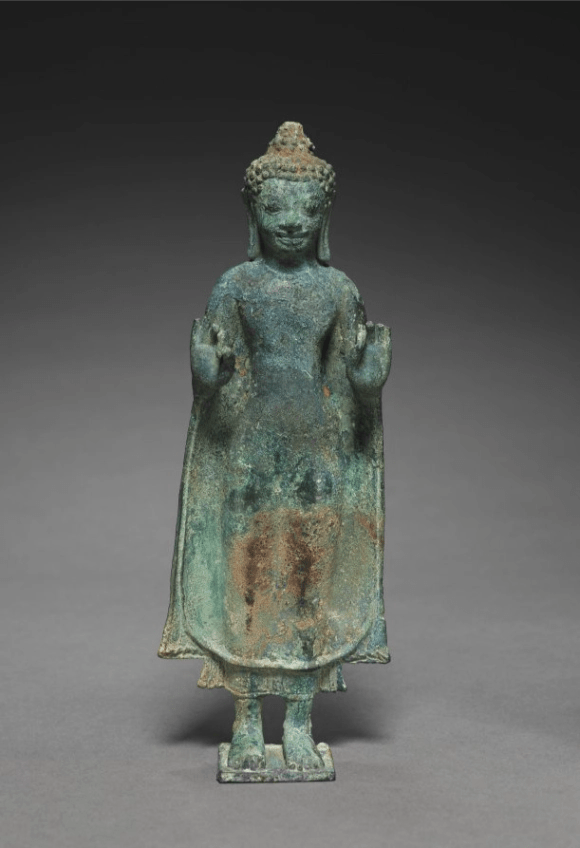
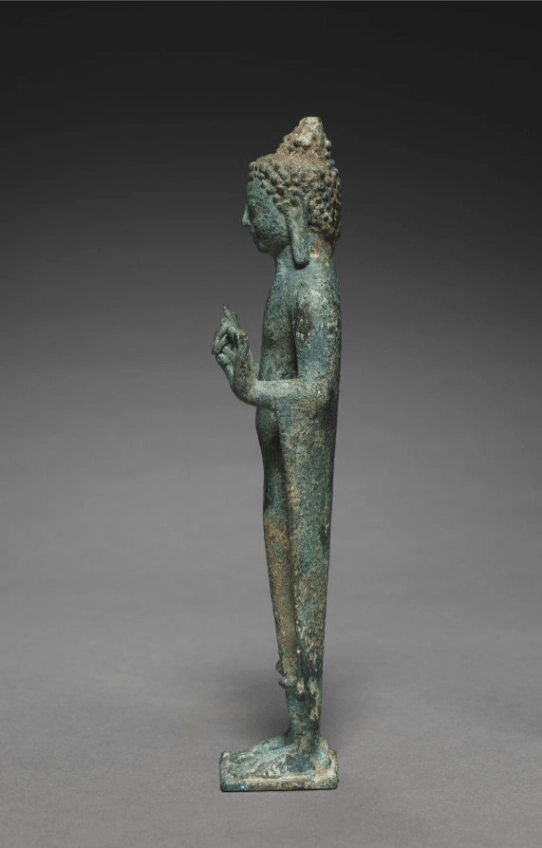
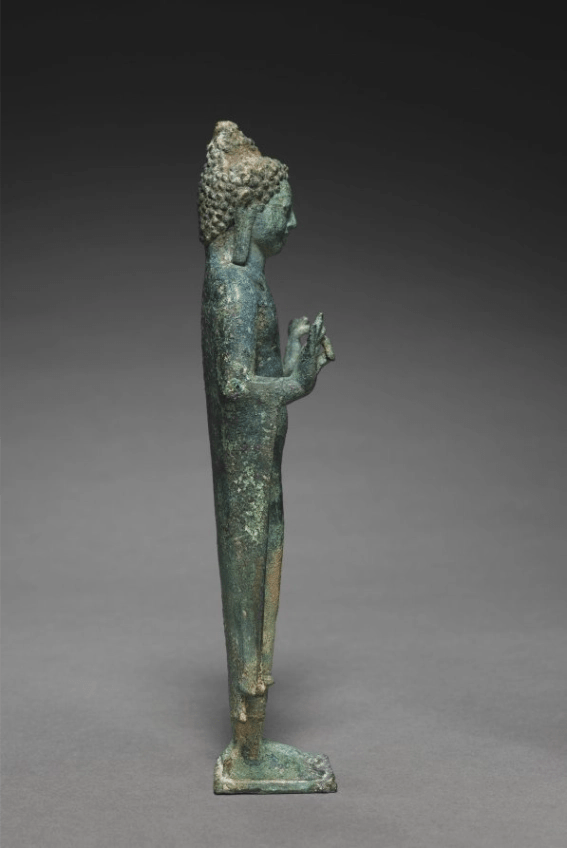
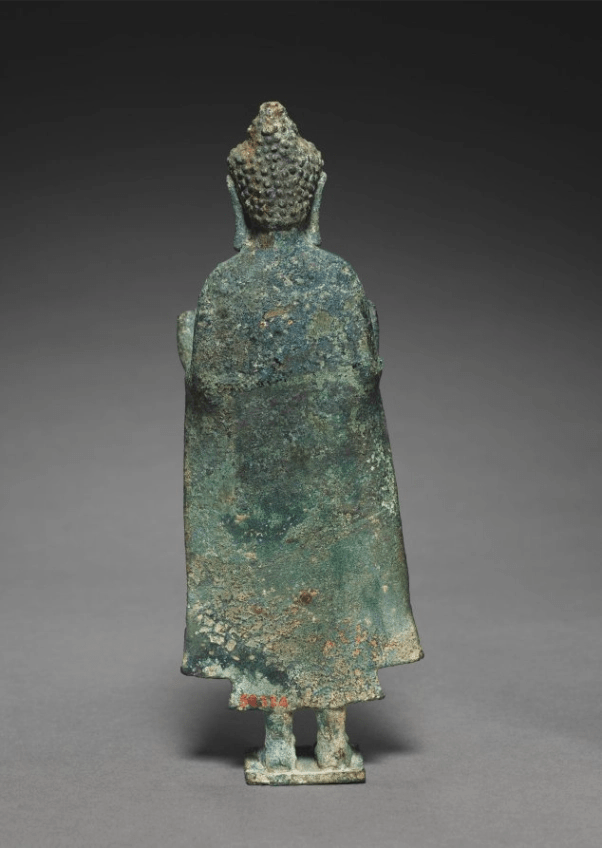
This bronze image of the teaching Buddha, shown with his hands raised in the gesture of teaching, is a small but eloquent work from 7th-century Thailand. Though modest in scale, it carries a quiet authority. The figure’s poised stillness, refined proportions, and carefully articulated hands give visual form to the act of transmitting wisdom, making the sculpture feel less like a static object than a concentrated expression of sacred presence and thought.
A Buddha from the Mon-Dvaravati World
The sculpture was created in the 7th century during the Mon-Dvaravati period, a formative era in the history of Buddhist art in central Thailand. At this time, the Mon kingdoms served as important centers for the transmission of Indian religious ideas into Southeast Asia. Buddhism flourished alongside elements of Hinduism, and artistic production reflected this richly layered environment. This figure belongs to the early development of Buddhist imagery in the region and shows clear connections to Indian models, especially those associated with Sarnath, where the historical Buddha is believed to have delivered his first sermon. At the same time, it already speaks in a regional voice, shaped by local interpretation rather than simple imitation.
A Distinctive Gesture of Teaching
One of the most striking aspects of the sculpture is its use of the double Vitarka Mudra. In this gesture, both hands form circles with the thumb and index finger, a feature that distinguishes Dvaravati imagery from many Indian precedents, where the teaching gesture is more often confined to the right hand alone. This variation gives the figure an added sense of balance and clarity, as though the whole body is engaged in the act of explanation and instruction. It also reveals the degree to which artists in the region were not merely borrowing Indian forms, but adapting them into something distinctively their own.
Wisdom Made Visible
The Vitarka Mudra symbolizes the Buddha’s role as teacher, and in this sculpture that idea is given unusually direct and elegant form. The image belongs to a larger tradition in which Buddhist art was used not only for devotion, but also for making doctrine visible. In the Mon-Dvaravati world, monasteries were centers of learning as well as worship, and sculptures like this would have stood within a religious culture deeply invested in the transmission of sacred knowledge. Artistically, the figure reflects the Dvaravati style at its most restrained and thoughtful, combining local sensibilities with the lingering influence of Gupta-period India. Its quiet robe, controlled posture, and emphasis on the hands all contribute to an image in which outward simplicity becomes the vehicle for inner meaning.
Bronze and Delicate Detail
The sculpture is cast in bronze and stands 21 cm high, or 8 1/4 inches. It was made using the lost-wax process, a technique widely practiced in Dvaravati metalwork and one that allowed for subtle modeling and fine surface detail. The robe is rendered with understated precision, including the hem crossing the ankles and a faint line at the waist that suggests the fastening of the garment. These small details give the figure a tactile clarity while preserving the overall serenity of the form. The result is a work that feels both materially solid and visually light.
From Thailand to Cleveland
The sculpture entered the collection of the Cleveland Museum of Art in 1958, when it was acquired from the New York dealer J. J. Klejman. It remains there today as a refined example of early Buddhist bronze sculpture from Thailand and as a witness to the artistic and spiritual world of the Mon-Dvaravati period.
-

Teaching Buddha – Museum Replica
Price range: €93,00 through €223,00


