
| Date | 100 – 300 CE |
| Place of origin | Pakistan |
| Culture/Period | Gandahar/Kushan Empire |
| Material/Technique | Gray schist |
| Dimensions | 18,2 cm or 7 3/16 in. tall |
| Current location | The Cleveland museum of art, USA |
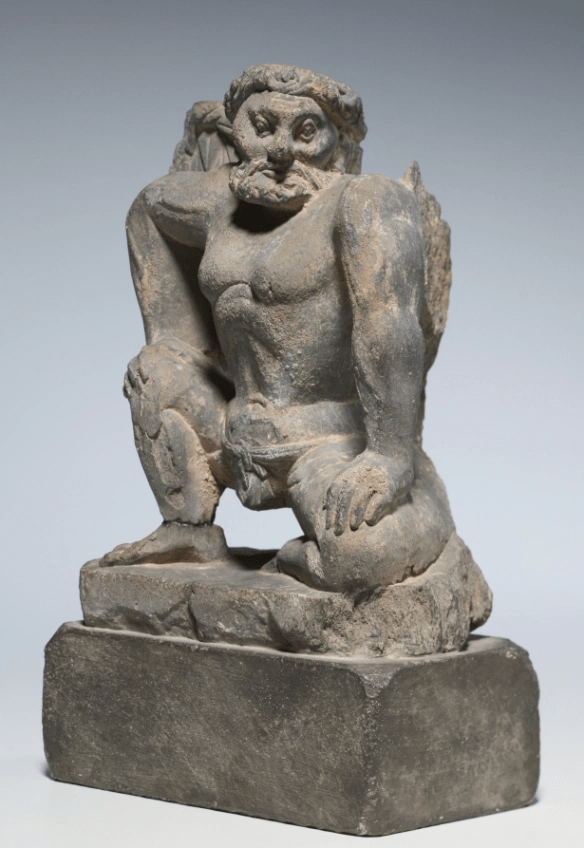
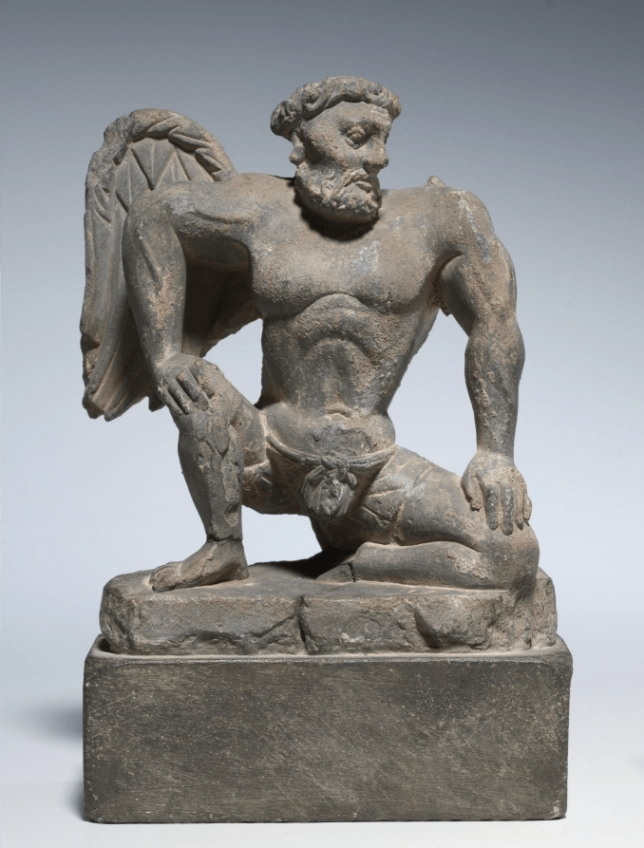
The Winged Atlas, a striking sculpture from the 2nd to 3rd century CE, is a remarkable example of the syncretic art of Gandhara, a region in present-day Pakistan. Crafted from gray schist and standing 18.2 cm or 7 3/16 inches tall, this figure blends Greek mythological motifs with Buddhist iconography, showcasing the cultural crossroads of the Kushan Empire. Housed in the Cleveland Museum of Art, the Winged Atlas captivates viewers with its delicate craftsmanship and symbolic richness, offering a glimpse into the fusion of Eastern and Western artistic traditions.
The sculpture was created during the Kushan period (c. 1st–3rd century CE), a time when the Kushan Empire ruled over parts of northern India, Pakistan, and Afghanistan. This empire was a hub of cultural exchange along the Silk Road, facilitating interactions between Greek, Roman, Persian, and Indian traditions. Gandhara, located in modern-day northwestern Pakistan and eastern Afghanistan, was a key center of Buddhist activity and artistic production. The region’s art was influenced by the Hellenistic legacy of Alexander the Great’s conquests in the 4th century BCE, as well as the patronage of Buddhism by Kushan rulers like Kanishka I. The Winged Atlas, dated to the 100s–200s CE, reflects this cosmopolitan environment, where Greek mythological figures like Atlas were reinterpreted within a Buddhist context.
Excavations in Gandhara, particularly at sites like Taxila and Jamalgarhi, often uncovered sculptures buried in Buddhist stupas, suggesting they were revered as sacred objects. One notable tale from the region involves the discovery of Gandharan artifacts by 19th-century British archaeologists, who were astonished by the Greek-like realism of Buddhist figures. The Winged Atlas, with its fusion of a Greek titan and Buddhist symbolism, likely sparked similar wonder among early scholars.
Gandharan culture during the Kushan period was a melting pot, blending Greek, Roman, Persian, and Indian influences. The sculpture’s depiction of Atlas, a Greek titan traditionally shown bearing the heavens, is adapted with wings—a feature unique to Gandhara and absent in classical Greek art. This addition likely symbolizes divinity, transcendence, or cosmic power, aligning with Buddhist themes of protection and enlightenment. The figure may also evoke Vajrapani, a Buddhist protector deity often depicted with attributes of Greek gods like Hercules or Zeus. In Buddhist stupas, such figures served as ornamental supports, symbolizing the upholding of the heavens or the Buddhist cosmos, thus integrating Greek mythology into a distinctly Indian spiritual framework.
The Winged Atlas is carved from gray schist, a durable stone commonly used in Gandharan sculpture for its fine grain, which allows for detailed carving. The sculpture measures 18.2 cm (7 3/16 in.) in height, making it a relatively small but intricately detailed piece. The gray schist’s smooth texture enhances the realistic modeling of the figure’s musculature and wings, reflecting the Hellenistic influence on Gandharan art. Gandharan sculptures typically involved hand-carving with chisels and polishing to achieve a refined finish.
The exact findspot of the Winged Atlas is not documented, but it likely originated from a Buddhist site in Gandhara, such as Taxila, Swat Valley, or Jamalgarhi, where similar sculptures have been excavated. Since its acquisition in 1924, the Winged Atlas has remained in the Cleveland Museum of Art, where it is displayed as part of its Asian art collection.
-

Winged Atlas – Museum Replica
Price range: €99,00 through €391,00


