
| Date | 100 – 300 CE |
| Place of origin | Pakistan |
| Culture/Period | Gandahar/Kushan Empire |
| Material/Technique | Gray schist |
| Dimensions | 18,2 cm or 7 3/16 in. tall |
| Current location | The Cleveland museum of art, USA |
| Licence | CC0 |
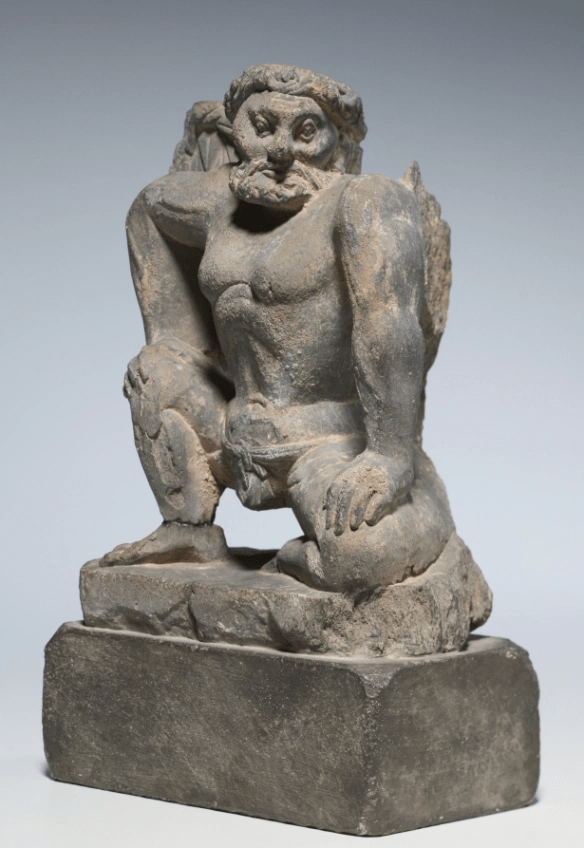
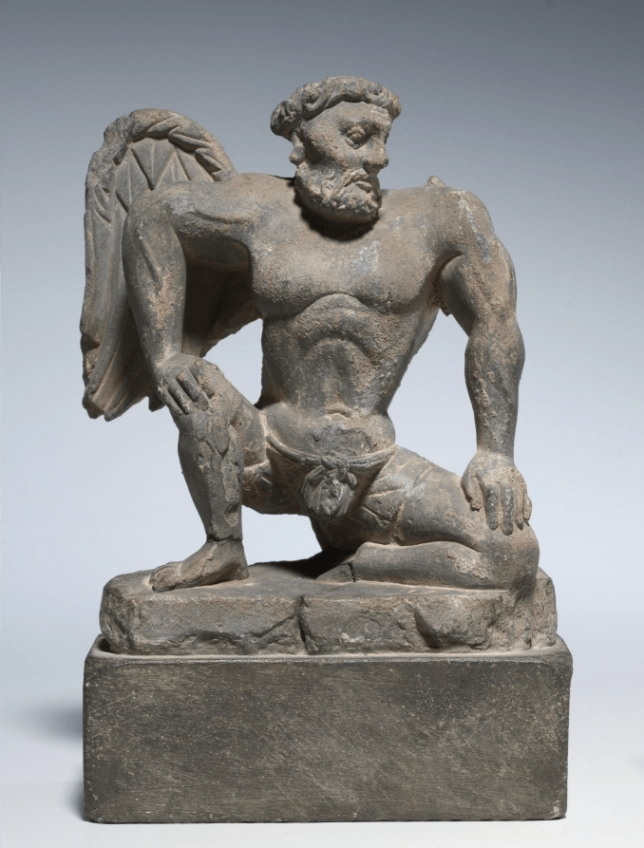
A small winged body bends under an invisible burden, and in that compact gesture an entire world of exchange becomes visible. The Winged Atlas is one of those Gandharan works that immediately unsettles neat categories. It looks toward Greek myth, yet belongs to a Buddhist setting; it carries the strength of classical sculpture, yet redirects that strength toward another sacred order. Though modest in size, it has unusual imaginative force. What might first seem like a decorative support becomes something far richer: a figure suspended between worlds, holding up not only weight, but meaning.
Gandhara and the Kushan World
The sculpture was made in the 2nd or 3rd century CE, during the Kushan period, when Gandhara was one of the great artistic crossroads of Asia. Stretching across parts of present-day Pakistan and Afghanistan, the region absorbed influences from Hellenistic, Roman, Persian, and Indian traditions, while also serving as an important center of Buddhist culture. This was not a peripheral world imitating distant models, but a place where visual languages were actively reworked. In that environment, figures from Greek mythology could be given new purpose, and Buddhist imagery could take on forms shaped by Mediterranean sculpture without losing its own religious depth.
Atlas Reimagined
In the Greek tradition, Atlas is the titan condemned to bear the heavens. Here, however, that old motif has been transformed. The supporting pose remains, but the addition of wings changes the figure’s character completely. Gandharan artists were not simply repeating classical imagery; they were reshaping it for a different symbolic world. The wings suggest elevation, divine force, or celestial status, and the figure’s function in a Buddhist architectural setting would have encouraged viewers to read it not as a mythological illustration, but as a being participating in the support of a sacred cosmos. That act of transformation is precisely what makes the sculpture so compelling.
Greek Form, Buddhist Meaning, and Sacred Setting
The Winged Atlas most likely came from a Buddhist site in Gandhara, perhaps from a stupa or monastic complex such as Taxila, Swat, or Jamalgarhi, where related sculptures have been found. In such places, supporting figures, guardians, and ornamental beings were not incidental decoration. They helped shape the visual and spiritual environment of the monument. This figure may also recall Vajrapani, the Buddhist protector who in Gandharan art sometimes absorbed traits associated with Greek heroic or divine types such as Heracles. Whether the identification is exact or not, the comparison is revealing. Gandharan sculptors were working in a visual language where bodies, poses, and mythic associations could move across traditions and acquire new meanings without feeling forced. The result is not a simple blend, but a genuinely new image: classical in form, Buddhist in setting, and distinctly Gandharan in spirit.
Material and Carving
The sculpture is carved from gray schist, the stone most characteristic of Gandharan art. At 18.2 cm (7 3/16 in.) in height, it is relatively small, yet the carving has real authority. Schist allowed for crisp detail and subtle modeling, and here it sharpens the tension between the compact muscular body and the lighter extension of the wings. The cool, silvery quality of the stone gives the figure a certain severity, while the careful workmanship keeps it from becoming heavy. Even as a fragment of a larger visual world, it feels complete in its own right.
Collection
Since 1924, the Winged Atlas has been in the Cleveland Museum of Art. Removed from its original architectural and devotional context, it still preserves the essential force of Gandharan art at its best: the ability to make cultural translation feel inventive rather than awkward, and to turn a small carved figure into a concentrated image of a world where traditions met, shifted, and became something new.
-

Winged Atlas – Museum Replica
Price range: €99,00 through €391,00


