
| Date | 1300s CE |
| Place of origin | Korea |
| Culture/Period | Goryeo Period |
| Material/Technique | Bronze |
| Dimensions | 17.8 x 6.6 cm (7 x 2 5/8 in.) |
| Current location | The Cleveland museum of art, USA |
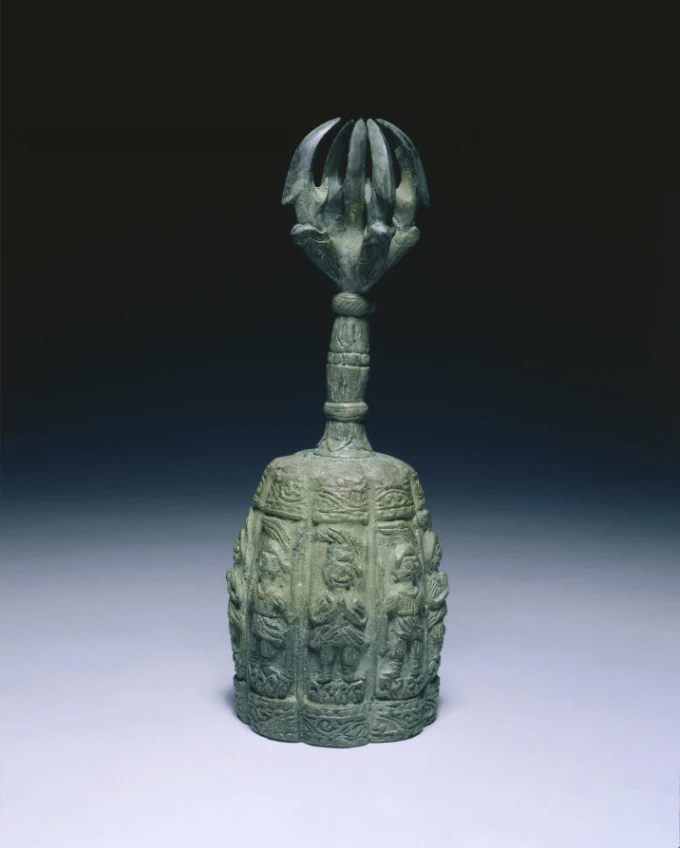
The Buddhist ritual bell, known as a vajra bell, is a bronze ceremonial object from Korea’s Goryeo period (918–1392 CE). This intricately designed artifact features incised patterns and a distinctive five-pronged vajra handle, symbolizing a lightning bolt or diamond in esoteric Buddhism. Used in rituals to destroy ignorance, the bell’s resonant sound and symbolic form make it a compelling example of Goryeo’s spiritual and artistic heritage.
Originating in the Goryeo period (918–1392 CE), a time of profound Buddhist influence in Korea, this bell was crafted in the 1300s. The Goryeo dynasty, centered in Kaesong, was a pinnacle of Korean Buddhist culture, marked by political stability and artistic innovation. Buddhism, introduced to Korea in the 4th century, became the state religion, shaping art, architecture, and ritual practices. Influenced by esoteric (Vajrayana) Buddhism from India via China and Tibet, Goryeo artisans produced ritual objects like this bell for temple ceremonies.
Objects like this were central to Goryeo’s esoteric rituals. Monks likely used such bells in ceremonies involving chanting and mandalas, with the bell’s sound believed to purify the environment and awaken spiritual awareness. The vajra handle, symbolizing Indra’s thunderbolt from Indian mythology, might have been revered as a protective force, with stories of its power to dispel negative energies circulating among practitioners.
The bell holds significant cultural and artistic value within Goryeo’s Buddhist context. Esoteric Buddhism, emphasizing complex rituals and meditation, was prominent in Goryeo, and this bell embodies its symbolic depth. The vajra, representing the indestructible force that cuts through ignorance, and the bell’s sound, symbolizing impermanence and purity, together express the unity of compassion and wisdom central to Vajrayana teachings. Artistically, the bell showcases Goryeo’s mastery of bronze casting and incised designs, often featuring lotus or geometric patterns. As a temple object, it also served as a status symbol, reflecting the piety and wealth of its patrons.
Crafted from bronze the Buddhist ritual bell measures 17.8 x 6.6 cm (7 x 2 5/8 in.). Its surface is adorned with incised patterns depicting Buddhist motifs such as lotus flowers and geometric shapes, characteristic of Goryeo’s sophisticated metalwork. The bell’s handle culminates in a five-pronged vajra, featuring four outer prongs curving toward a central prong, a design symbolizing the five wisdoms or elements in esoteric Buddhism. This intricate bronze casting and engraving reflect the advanced technical skills of Goryeo artisans, who combined functionality with aesthetic and spiritual significance.
The bell’s exact provenance is undocumented, but it was likely created for a Buddhist temple in Goryeo’s capital, Kaesong, or a nearby religious center. Many such objects were commissioned by aristocratic donors or monastic communities. Over time, it made its way to The Cleveland Museum of Art, where it is now preserved as part of its Asian art collection.


-

Buddhist Ritual Bell – Museum Replica
Price range: €93,00 through €349,00


