
| Date | c. 1400s-1500s CE |
| Place of origin | Tibet |
| Culture/Period | Tibetan renaissance |
| Material/Technique | Silver-copper alloy |
| Dimensions | 12.5 x 8 x 6.5 cm (4 15/16 x 3 1/8 x 2 9/16 inches) |
| Current location | The Cleveland museum of art, USA |
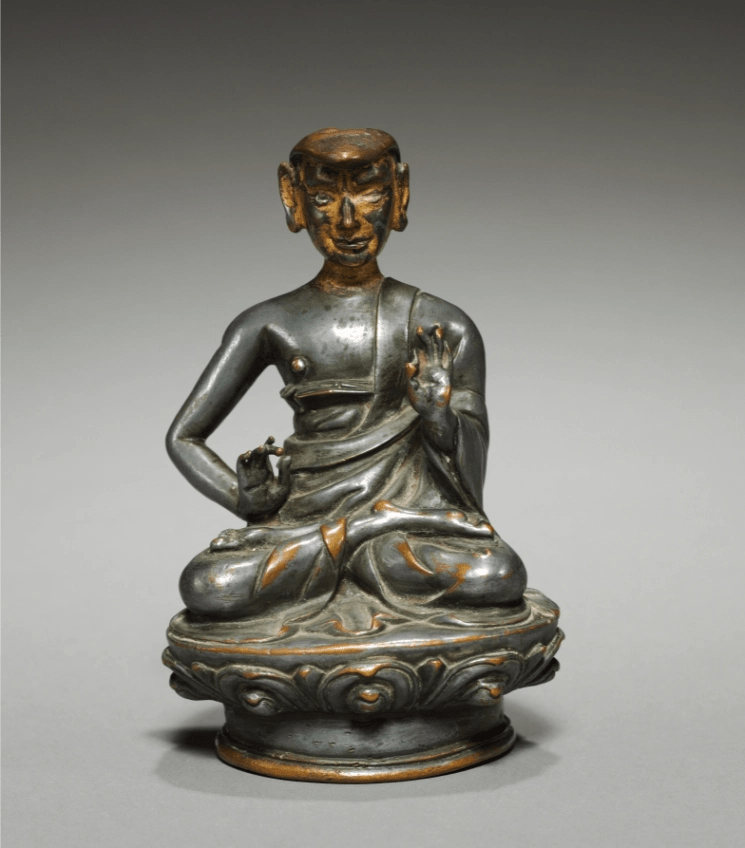
The Portrait of Dharmakirti is a small, intricately crafted sculpture from Tibet, dating to the 1400s or 1500s CE. Fashioned from a silver-copper alloy, it depicts the revered Indian Buddhist philosopher Dharmakirti who lived between ca. 600–670 CE. This object, part of the Cleveland Museum of Art’s collection, captivates with its delicate craftsmanship and profound spiritual significance. Inscribed on the back near the lotus petals with “Cho [kyi] Drak [pa],” the Tibetan name for Dharmakirti, it offers a glimpse into the rich Buddhist artistic tradition of Tibet.
The Portrait of Dharmakirti originates from Tibet during a period of cultural and religious flourishing in the 1400s–1500s. This era saw the consolidation of Buddhist schools such as Gelug, founded by Tsongkhapa (1357–1419 CE), and the continued influence of Sakya and Kagyu traditions. The sculpture was likely produced in a monastic workshop, possibly in central Tibet’s Tsang or Ü regions, areas renowned for their artistic output. Dharmakirti, the subject, was a 7th-century Indian philosopher at Nālandā University, whose works on epistemology and logic, particularly Pramāṇavārttika, profoundly shaped Buddhist thought. His ideas were transmitted to Tibet, becoming central to the curriculum of monastic education. The sculpture’s creation, centuries after Dharmakirti’s life, reflects his enduring legacy in Tibetan Buddhism.
Its creation aligns with Tibet’s tradition of venerating great Buddhist thinkers through art. Such sculptures were often commissioned by lamas or monasteries to honor figures like Dharmakirti, whose philosophical debates reportedly included a legendary rivalry with his uncle, the Mīmāṃsā philosopher Kumārila Bhaṭṭa. According to Tibetan hagiographies, Dharmakirti, originally a Brahmin, converted to Buddhism after a philosophical dispute with Kumārila and vowed to defeat non-Buddhist scholars. This narrative underscores Dharmakirti’s significance and may have inspired the creation of devotional objects like this portrait.
The Portrait of Dharmakirti holds profound cultural and religious importance within Tibetan Buddhist art. Depicting Dharmakirti in the lotus position (vajra posture) atop a stylized lotus pedestal, it embodies Buddhist ideals of stability, purity, and enlightenment. The hand gestures—likely variants of vitarka mudra (teaching or argumentation)—reflect Dharmakirti’s role as a logician and epistemologist. Such sculptures were integral to Vajrayana Buddhist practice, serving as focal points for meditation, ritual, or altar veneration in monasteries or temples. The object’s craftsmanship, influenced by Newari artisans from Nepal, highlights the cultural exchange along trade routes like the Silk Road. Its use gilding underscores the Tibetan aesthetic of enhancing sacred objects with vibrant hues and gold to evoke divine presence.
The sculpture is crafted from a silver-copper alloy, a material prized in Tibetan art for its durability and lustrous finish. The use of silver added prestige, while copper ensured structural integrity. Likely created using the lost-wax casting technique, the sculpture measures 12.5 x 8 x 6.5 cm (4 15/16 x 3 1/8 x 2 9/16 inches). Dharmakirti is depicted seated on a double-layered lotus pedestal, a symbol of purity. Traces of gilding, possibly applied using cold gold techniques, indicate the sculpture was originally more vibrant. The inscription “Cho [kyi] Drak[pa]” near the lotus petals was likely incised post-casting, identifying the figure. The fine detailing of the lotus base and hand gestures suggests the involvement of skilled artisans, possibly Newari craftsmen.
No significant damages are noted in available records, suggesting careful handling throughout its history. Conservation efforts at the Cleveland Museum of Art focus on stabilizing the silver-copper alloy to prevent corrosion and preserving the remaining gilding and color traces. Standard practices for such objects include controlled storage environments to mitigate environmental degradation.
-

Portrait of Dharmakirti – Museum replica
Price range: €93,00 through €343,00


