
| Date | 1345 CE |
| Place of origin | China |
| Culture/Period | Yuan dynasty |
| Material/Technique | Silver |
| Dimensions | 16 cm (6 5/16 inches) in height |
| Current location | The Cleveland museum of art, USA |
| Licence | CC0 |
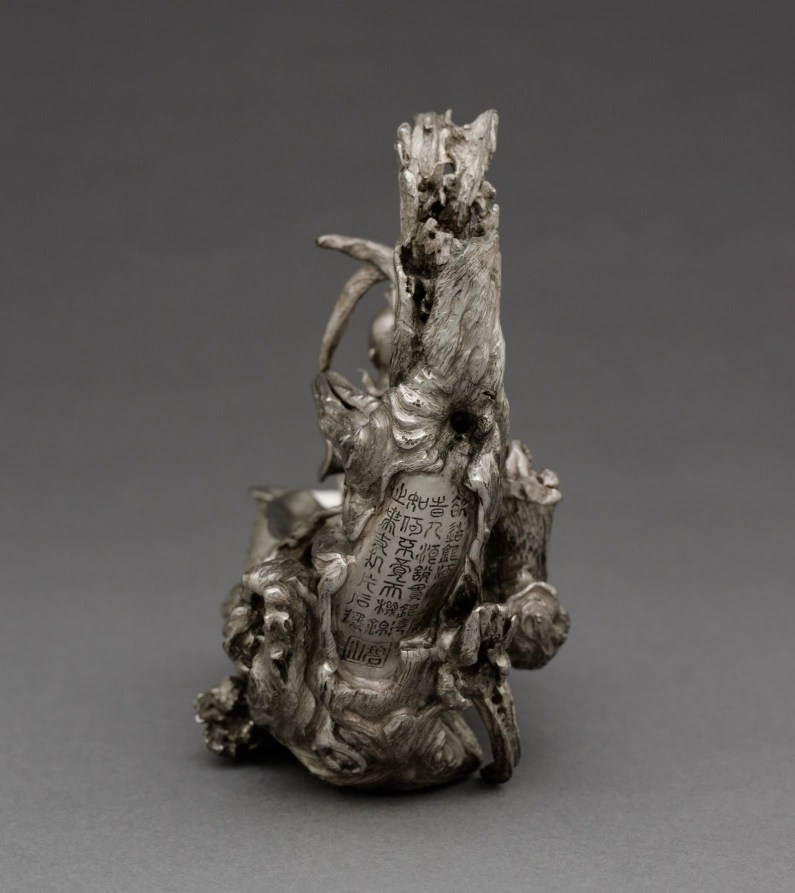
At first glance it appears to be a vessel shaped from driftwood, yet the longer one looks, the more the silver seems to dissolve into story. A tiny traveler stands within the form of a raft-like cup, turning an object made for drinking into an image of wonder, journey, and cosmic encounter. The Raft Cup brings together technical brilliance and poetic imagination, transforming precious metal into something at once tactile, elegant, and deeply evocative of Yuan dynasty elite culture.
A Silver Vessel from the Yuan World
Made in 1345 during the Yuan dynasty, the Raft Cup belongs to a period when China was ruled by the Mongols and connected more intensely than ever to the wider world of Asia. Artistic production during this time could draw on Chinese traditions while also absorbing influences carried along the Silk Road, and luxury objects such as this one reflect that wider cosmopolitan setting. The cup is attributed to Zhu Bishan, one of the very few Chinese silversmiths from the period whose name is still known. Active in the Lake Tai region near Suzhou, he became so admired for his refined silverwork that his name itself seems to have functioned almost like a mark of prestige, imitated by others who hoped to borrow some of his reputation. This vessel emerges from that environment of sophistication, patronage, and artistic competition.
Zhang Qian and the Poetry of the Raft
What gives the cup its deeper resonance is the story worked into its surface. The imagery is traditionally understood to represent Zhang Qian, the Han dynasty envoy who later became associated in legend with a fantastical journey into the heavens. In that story, he encounters the Weaving Maid in the Milky Way and receives a loom stone, linking him to one of the most beloved narratives in Chinese tradition: the celestial meeting of the Weaving Maid and the Cowherd, celebrated in the Qixi Festival. That mythological association gives the cup a lyrical dimension. It was not simply an object for wine, but a vessel that could carry conversation, learned allusion, and poetic memory into the gathering where it was used.
Luxury, Ritual, and Elite Taste
As a wine cup, the object would have belonged to a world of cultivated sociability. In Yuan elite culture, drinking was often closely tied to poetry, storytelling, and the performance of learning, and a vessel like this would have done far more than hold liquid. Its unusual form, its narrative detail, and its precious material would all have contributed to its role within refined company. The raft motif itself suggests movement, travel, and passage between worlds, while the celestial imagery connects the vessel to larger ideas of harmony and cosmic order. The cup thus stands at the meeting point of craftsmanship and literary culture, embodying the taste for objects that could delight the hand, the eye, and the mind at once.
Silver, Surface, and Technical Mastery
The Raft Cup is made of pure silver and stands 16 cm high, or 6 5/16 inches. It was assembled from multiple hammered pieces shaped into the form of a hollow log and then soldered together with remarkable precision. The surface is enriched with chased decoration, a demanding technique in which details are incised and raised to create subtle, lively imagery. The figure of Zhang Qian, together with the inscribed loom stone, emerges from this careful work, while the dated inscription and Zhu Bishan’s seal further anchor the object in a specific artistic world. The cup’s technical refinement is one of its great achievements: it feels at once natural in form and highly controlled in execution, a balance that speaks to the exceptional skill of its maker.
From Yuan China to Cleveland
The early ownership of the Raft Cup is not fully documented, but it was almost certainly made for a wealthy patron, whether a scholar-official, merchant, or member of the Yuan elite. Produced in one of the most artistically active regions of southern China, it would have circulated in a milieu where precious objects were valued not only for cost and craftsmanship, but for their ability to embody culture and intellect. Today it is preserved in the Cleveland Museum of Art, where it remains one of the most remarkable survivals of Yuan silverwork and a rare witness to the artistry associated with Zhu Bishan’s name.


-

Raft Cup – Museum Replica
Price range: €101,00 through €501,00


