
| Date | c. 1400s-1500s CE |
| Place of origin | Tibet |
| Culture/Period | Tibetan renaissance |
| Material/Technique | Silver-copper alloy |
| Dimensions | 12.5 x 8 x 6.5 cm (4 15/16 x 3 1/8 x 2 9/16 inches) |
| Current location | The Cleveland museum of art, USA |
| Licence | CC0 |
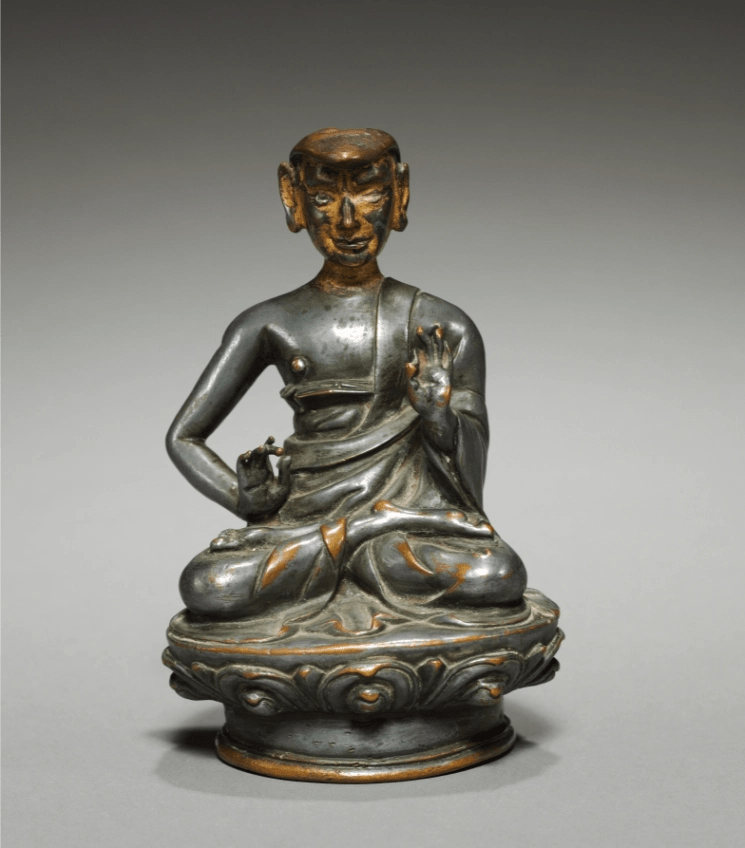
Compact in scale yet quietly commanding, this Tibetan portrait turns philosophical authority into sacred presence. Dharmakirti sits in deep composure on a lotus throne, his gestures poised between teaching and contemplation, as if the force of his thought had been distilled into metal. The sculpture does not merely commemorate a learned master from the distant Indian past. It makes him present within the devotional life of Tibet, where reasoning, meditation, and spiritual discipline were understood to belong to the same path.
A Tibetan Image of a Great Buddhist Thinker
This sculpture was made in Tibet in the 15th or 16th century, during a period of intense religious and artistic vitality. By then, Tibetan Buddhism had developed a rich tradition of portraying not only Buddhas and bodhisattvas, but also the great scholars whose writings shaped monastic learning and debate. Dharmakirti, the 7th-century Indian philosopher depicted here, held a particularly important place in that tradition. His works on logic, perception, and valid cognition became central to Tibetan scholastic education, especially in the great monasteries where rigorous intellectual training formed part of the path to enlightenment. A portrait like this therefore did more than honor a historical figure. It embodied the continuity of Buddhist thought across centuries and across the movement from India into Tibet.
Dharmakirti in Tibetan Memory
By the time this sculpture was created, Dharmakirti had long since entered Tibetan Buddhist culture not simply as an author, but as a near-legendary authority. His philosophical writings, especially on epistemology and reasoning, were copied, memorized, debated, and commented upon for generations. Tibetan tradition also preserved stories of his intellectual power, including accounts of his conversion from a Brahmin background and his triumph in debates against non-Buddhist thinkers. Whether or not such stories can be taken literally, they reveal how deeply he was admired: not only as a scholar, but as someone whose clarity of mind had religious force. This portrait belongs to that atmosphere of reverence.
Philosophy as Sacred Presence
What makes the object so compelling is that it translates intellectual authority into devotional form. Dharmakirti is shown seated in lotus posture on a double lotus base, a position associated with stability, concentration, and spiritual attainment. His hands appear to form gestures related to teaching or argumentation, which is especially fitting for a thinker whose legacy rested on disciplined reasoning and debate. In Tibetan Buddhism, such an image would not have been merely commemorative. It could serve as an aid to meditation, a focus of ritual attention, or a visual reminder of the inseparability of wisdom and practice. The sculpture thus reflects a specifically Tibetan understanding of knowledge: true philosophical insight was not separate from liberation, but part of the path toward it.
Tibetan Art and Cross-Cultural Craftsmanship
The work also speaks to the cosmopolitan artistic world of Tibet. Its style and finish suggest the influence of Newari metalworking traditions from Nepal, whose artisans played a major role in shaping Tibetan Buddhist sculpture. Such exchanges were common across the Himalayan world, where trade, pilgrimage, and monastic networks brought artistic forms into constant circulation. Even in a small sculpture like this, one can feel that meeting of traditions: Indian philosophy, Tibetan devotion, and Himalayan craftsmanship brought together in a single object.
Silver-Copper Alloy, Gilding, and Scale
The portrait is made of silver-copper alloy and measures 12.5 × 8 × 6.5 cm, or 4 15/16 × 3 1/8 × 2 9/16 inches. The alloy gave the sculpture both strength and a refined surface, while traces of gilding suggest that it would originally have had a richer, more radiant appearance. It was likely made using the lost-wax casting technique, which allowed the artisan to produce the detailed lotus base, the subtle modeling of the figure, and the finely controlled hand gestures. The inscription on the back near the lotus petals, reading “Cho [kyi] Drak[pa],” identifies the figure by his Tibetan name and anchors the object firmly in the scholastic and devotional culture that preserved his legacy.
Preserved in Cleveland
The sculpture is now in the collection of the Cleveland Museum of Art, where it remains an intimate but powerful example of Tibetan Buddhist portrait sculpture. Though small, it carries the full weight of a tradition in which philosophical mastery itself could become an object of reverence, contemplation, and artistic devotion.
-

Portrait of Dharmakirti – Museum Replica
Price range: €93,00 through €343,00


