
| Date | Ca. 1600 BCE |
| Place of origin | Northern Syria |
| Culture/Period | Hittite Empire |
| Material/Technique | Basalt |
| Dimensions | 87.6 cm (34 1/2 in.) tall |
| Current location | The Cleveland Museum of Art, USA |
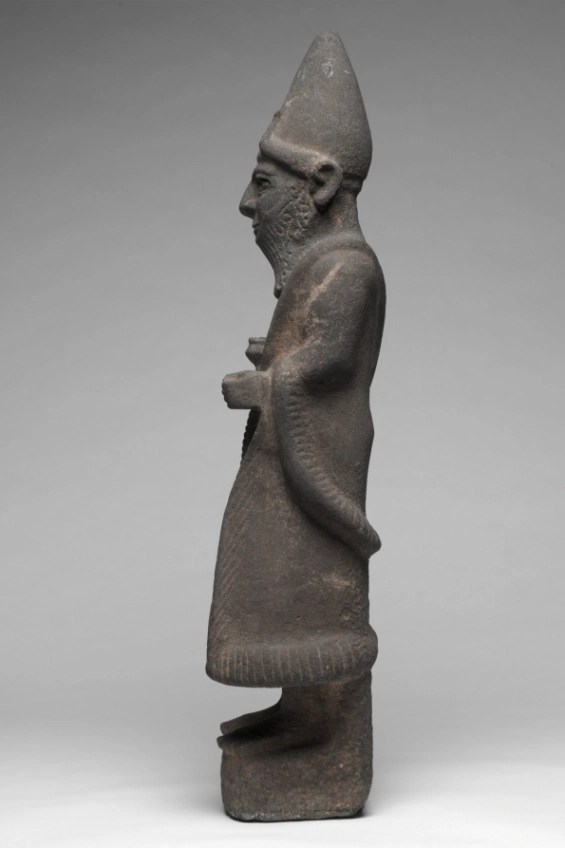
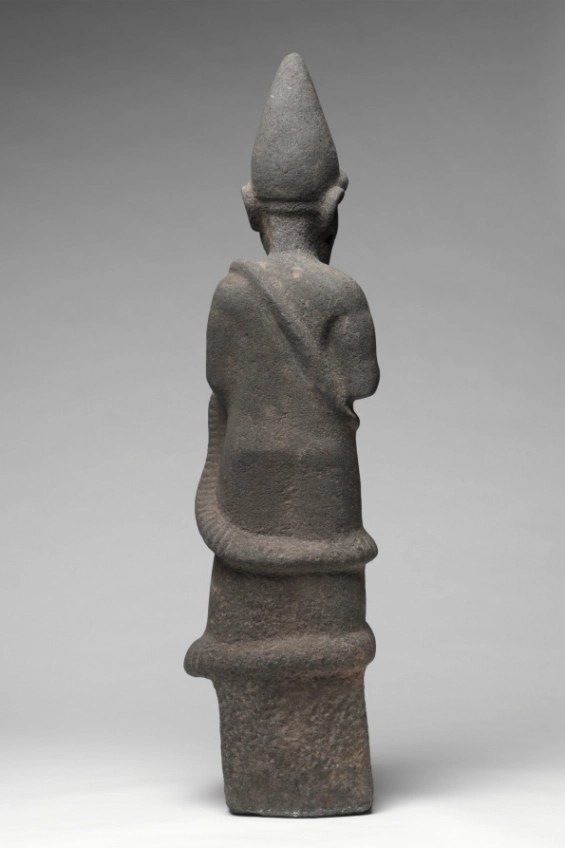
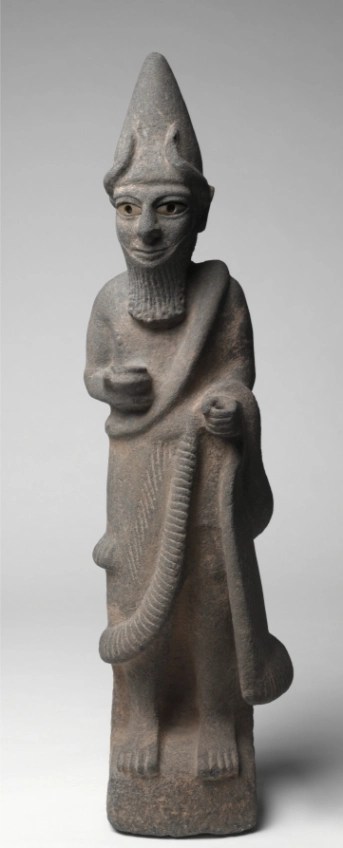
The basalt sculpture known as the Priest-King or Deity, dating to around 1600 BCE, is a striking artifact from the Hittite civilization of North Syria. Crafted from fine-grained basalt—a volcanic rock that dominates Earth’s crust—this imposing figure stands at 87.6 cm (34 1/2 in.) tall, adorned with a horned conical crown, false beard, and long robe. With a bowl in its right hand and the left hand once holding an object (possibly a staff or sword), the sculpture’s commanding presence and rare bone-inlaid eyes offer a captivating glimpse into the artistry and beliefs of an ancient Indo-European people who shaped Bronze Age Anatolia.
Basalt, formed from the rapid cooling of magnesium- and iron-rich lava, is one of the most abundant volcanic rocks on Earth, making it a fitting medium for the Hittites, whose empire thrived in the rugged landscapes of Anatolia (modern-day Turkey) and northern Syria. The Priest-King or Deity sculpture emerged during the height of the Hittite Old Kingdom (c. 1600–1200 BCE), a period marked by territorial expansion and cultural exchange. The Hittites, who migrated into Anatolia in the 3rd millennium BCE, established their capital at Hattusa and became a dominant power by the mid-14th century BCE under rulers like Šuppiluliuma I. This sculpture, likely created around 1600 BCE, reflects the Hittites’ early mastery of stone carving and their role as a conduit for Mesopotamian influences across the Mediterranean world.
The left eye, an original bone inlay, contrasts with the right, a modern restoration, hinting at an untold story of damage—perhaps from conflict, looting, or natural decay during the Hittite Empire’s collapse around 1200 BCE. One can imagine this figure presiding over a temple or palace, witnessing the Hittites’ triumphs, such as Mursilis I’s raid on Babylon (c. 1590 BCE), or their epic clash with Egypt at Kadesh (1299 BCE). Its stoic gaze might have silently observed the empire’s fall to Phrygian invaders and the Sea Peoples, only to resurface millennia later as a testament to Hittite endurance.
Depicting either a god or a priest-king—a figure seen as the earthly deputy of the storm god—this sculpture reflects the Hittites’ tolerant polytheism, which blended indigenous Anatolian deities with Syrian and Hurrian influences. The horned crown symbolizes divinity or authority, a motif shared across ancient Near Eastern cultures, while the false beard and robe suggest ritualistic or regal status. Its rarity as a large-scale Hittite basalt figure underscores the civilization’s artistic prowess and its role in bridging Mesopotamian and Mediterranean traditions. Likely used in religious or ceremonial contexts, it embodies the Hittites’ fusion of power and spirituality.
Carved from basalt, an aphanitic (fine-grained) extrusive igneous rock, the sculpture showcases the Hittites’ skill in working with hard, durable materials. Basalt’s dark, uniform texture, formed by rapid lava cooling, contrasts with the delicate bone inlays of the eyes—one ancient, one restored—adding a lifelike quality to the figure. Measuring 87.6 cm in height, it is monumental yet detailed, with the horned crown, robe, and handheld bowl meticulously shaped. The missing object in the left hand, possibly a staff or sword, hints at its original completeness, while the basalt’s natural strength has preserved it through millennia.
Originating in North Syria, a region under Hittite control during the empire’s peak, the sculpture’s early journey remains obscure. Unearthed in modern times, it eventually found its way to the Cleveland Museum of Art, where it resides today. Its path likely involved archaeological excavation in the 19th or 20th century, a period when Hittite sites like Hattusa and Kültepe yielded treasures that reshaped our understanding of this lost civilization.
Today, the Priest-King or Deity captivates scholars and visitors alike as a window into Hittite culture and the Bronze Age Near East. Its significance lies in its rarity and the questions it raises: Is it a god or a mortal ruler? What did it once hold? Ongoing research in Hittitology, spurred by excavations at Hattusa and the decipherment of cuneiform texts, continues to illuminate the Hittites’ world, with this sculpture serving as a tangible link to their legacy.


-

Priest King or Deity – Museum Replica
Price range: €94,00 through €228,00


