
| Date | c. 900 CE |
| Place of origin | Japan |
| Culture/Period | Heian period |
| Material/Technique | Wood |
| Dimensions | 57.2 cm (22 1/2 in.) in height, 46.4 cm (18 1/4 in.) in width, and 38.1 cm (15 in.) in depth. |
| Current location | The Cleveland museum of art, USA |
| Licence | Shakyamuni · by Cleveland Museum of Art · CC BY 4.0 |
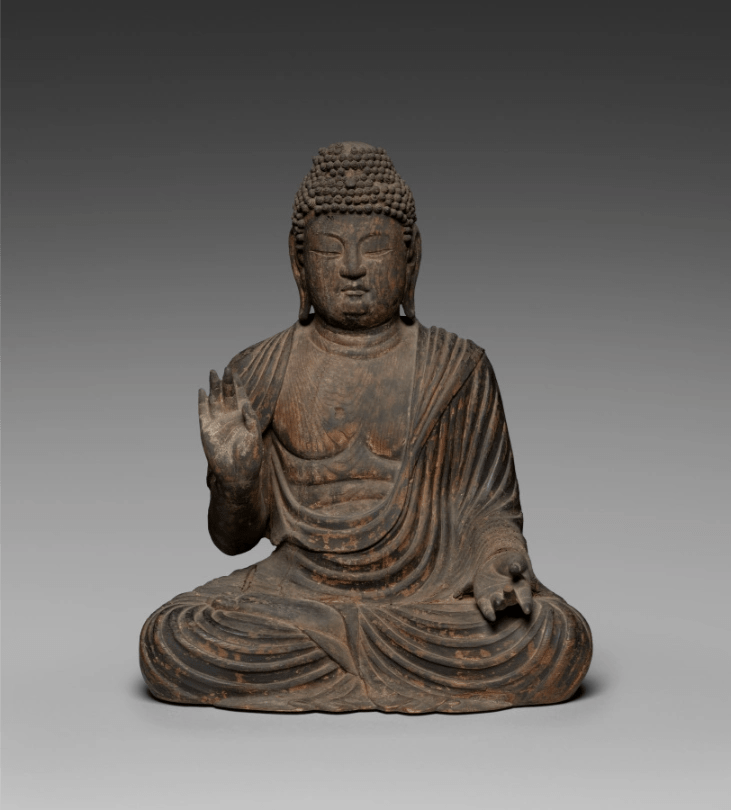
He sits in absolute calm, yet the sculpture is full of quiet force. One hand rests in meditation, the other rises in reassurance, and the whole figure seems to gather stillness into a visible form. In this Heian-period image of Shakyamuni, the historical Buddha is not shown in dramatic action, but in a state of awakened presence, where serenity itself becomes the deepest expression of power.
A Buddha for Devotion in Heian Japan
This sculpture was made in Japan around 900 CE, during the Heian period, when Buddhist art was becoming one of the most important vehicles of spiritual and cultural expression. By this time, Buddhism had already been established in Japan for centuries, but the Heian era saw its imagery take on a more refined and distinctly Japanese character. Influences from Tang China remained strong, yet sculptors and patrons increasingly shaped Buddhist forms according to local aesthetic and devotional needs. This image of Shakyamuni, the historical Buddha, belongs to that moment of adaptation, when imported religious traditions were being transformed into something fully rooted in Japanese religious life.
The Historical Buddha in Sacred Form
Shakyamuni was Siddhartha Gautama, the historical Buddha who lived in northern India and attained enlightenment after a long spiritual quest. In East Asian Buddhist art, his image was never simply biographical. It became the focus of meditation, worship, and ritual, a way of making his presence available across time and place. This sculpture translates that presence into a poised, balanced figure whose gestures carry precise meaning. The left hand, resting in the lap with thumb and middle finger touching, forms the dhyana mudra, the gesture of meditation and inner concentration. The raised right hand forms the abhaya mudra, offering fearlessness and protection. Together, these gestures create a figure who is both inwardly absorbed and outwardly compassionate.
Style and Spiritual Meaning
The sculpture reflects a key moment in the development of Japanese Buddhist style. The heavy, raised folds of the robe give the figure a rhythmic sculptural strength, while the face remains composed and inward. This combination of formal structure and spiritual calm is one of the hallmarks of early Heian Buddhist art. The elongated ears and tightly curled hair are not decorative conventions alone, but signs of the Buddha’s exceptional nature, inherited from older Indian and Buddhist traditions that described the physical marks of a fully enlightened being.
In Heian Japan, such an image would likely have stood in a temple or aristocratic devotional setting, where it served not only as an object of reverence but as a focus for contemplation. Buddhist sculpture at this time was deeply tied to ritual life, and images of Shakyamuni were approached as presences capable of mediating protection, merit, and spiritual insight.
Wood, Lacquer, and Carved Form
The sculpture is carved from a single block of wood using the ichiboku-zukuri technique, a method that gives the figure both structural unity and sculptural solidity. It measures 57.2 cm in height, 46.4 cm in width, and 38.1 cm in depth, or 22 1/2 × 18 1/4 × 15 inches. The surface was finished with lacquer and originally bore color, traces of which still survive. The garment folds are deeply and carefully carved, creating a strong sense of pattern and movement across the body, while the treatment of the head and hands shows equal attention to sacred iconography and formal balance. Even with some loss of surface color, the image retains a remarkable quiet authority.
From Heian Japan to Cleveland
The sculpture was likely created for a temple or elite devotional setting in Heian-period Japan, where it may have been venerated for many centuries before eventually entering the modern art market. It is now in the collection of the Cleveland Museum of Art, where it remains a powerful example of early Japanese Buddhist sculpture and of the enduring visual language through which the Buddha’s presence was made tangible.


-

Shakyamuni – Museum Replica
Price range: €108,00 through €374,00


