
| Date | c. 1000 CE |
| Place of origin | Tamil Nadu, India |
| Culture/Period | India/Chola Period |
| Material/Technique | Bronze |
| Dimensions | 76.5 x 45 cm (30 1/8 x 17 11/16 in.), with hollow base 26 x 25 cm (10 1/4 x 9 13/16 in.) |
| Current location | The Cleveland museum of art, USA |
| Licence | CC0 |
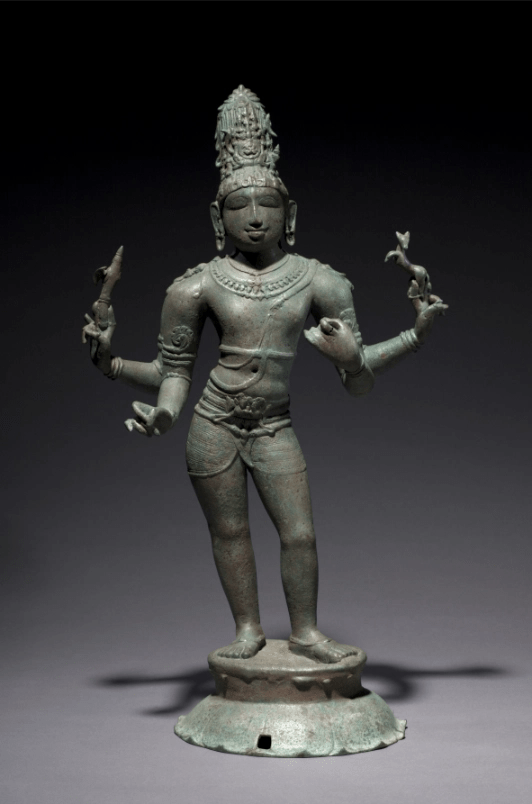
He stands in perfect stillness, yet everything about him suggests sound. The lifted hands, the poised fingers, the quiet balance of the body all imply music that is no longer visible but still somehow present, as if the bronze itself remembers the notes once drawn from the missing vina. In this Chola image of Shiva as Lord of Music, divinity is not expressed through force or spectacle, but through harmony, rhythm, and the serene authority of a god who orders the cosmos through sound.
A Sacred Bronze from Chola South India
This sculpture was made around 1000 CE in Tamil Nadu during the Chola period, one of the great ages of South Indian art. Under the Chola dynasty, bronze casting reached an extraordinary level of refinement, especially in images of Hindu deities created for temple worship and procession. These bronzes were not conceived as static museum objects, but as living embodiments of the divine, carried through temple streets, dressed, adorned, and brought into the presence of devotees. This image of Shiva belongs to that world of intense ritual life, where art, devotion, music, and movement were inseparable.
Shiva as Lord of Music
Here Shiva appears in one of his gentler and more contemplative forms, revered as the divine patron of music. The lower hands are positioned to play a vina, now lost, while the upper hands hold an axe and a rearing antelope. Even without the instrument itself, the image remains deeply musical. The body is composed with extraordinary balance, and the hand gestures retain the memory of performance. Shiva is not shown in the explosive energy of Nataraja, but in a quieter mode, where cosmic power takes the form of harmony and inner control.
Music, Worship, and Cosmic Order
In the religious world of the Cholas, music was not merely an ornament to ritual. It was part of the sacred fabric of temple life. Hymns, chanting, and instrumental performance were understood as offerings to the deity, and sound itself could be seen as a manifestation of the cosmic principle underlying creation. In that context, Shiva’s association with the vina carried profound meaning. He becomes the source of nada, the sacred sound that sustains the universe. The axe in his upper hand signifies the cutting away of ignorance, while the antelope suggests mastery over the restless mind and knowledge of sacred truth. Together, these attributes make the sculpture not only an image of musical grace, but of spiritual discipline and divine wisdom.
Chola Bronze and Living Ritual
The sculpture is cast in bronze using the lost-wax technique, the process for which Chola artisans are especially celebrated. It measures 76.5 × 45 cm, or 30 1/8 × 17 11/16 inches, and the hollow base, measuring 26 × 25 cm, or 10 1/4 × 9 13/16 inches, was designed to accommodate poles for carrying the image in procession. That detail is crucial, because it reminds us that this bronze once moved through ritual space. Its polished surface and elegant modeling would have caught light beautifully during worship, while the missing vina may once have been made separately and attached, perhaps in wood or metal. The fluid lines, delicate fingers, and calm expression reveal the Chola ideal of divine beauty: poised, graceful, and inwardly radiant.
From Temple to Museum
Like many Chola bronzes, the sculpture’s early history is not fully documented, though it likely remained in a temple context in Tamil Nadu for centuries. Its later movement into the art market reflects the broader dispersal of South Asian sacred objects during the colonial and postcolonial periods. Today it is in the Cleveland Museum of Art, where it survives as one of the most eloquent expressions of Chola bronze casting and of Shiva’s role as the divine source of music, order, and grace.


-

Shiva as Lord of Music – Museum Replica
Price range: €94,00 through €288,00


