
| Date | c. 700-750 CE |
| Place of origin | Kashmir, India |
| Culture/Period | India |
| Material/Technique | Brass |
| Dimensions | 50.4 cm (19 13/16 in.) tall |
| Current location | The Cleveland museum of art, USA |
| Licence | CC0 |
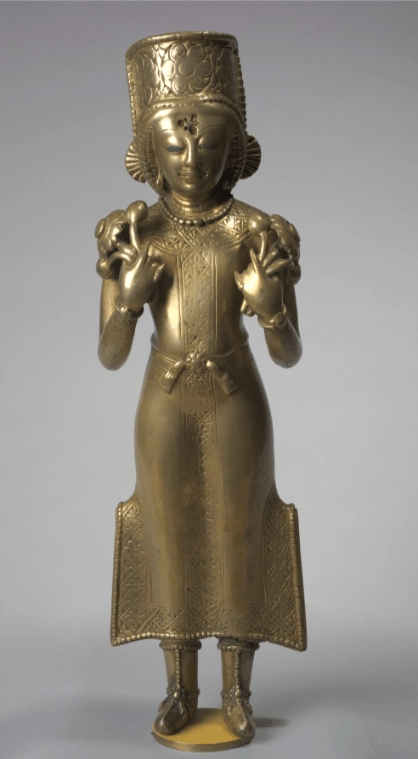
He stands frontal and commanding, clothed not in the flowing garments one might expect of an Indian god, but in a long tunic and high boots that immediately hint at a wider world beyond Kashmir. The effect is arresting. Surya appears at once unmistakably divine and culturally layered, a sun god whose image gathers together India, Central Asia, and Persia in a single radiant form. This sculpture does not simply represent a deity. It reveals how far ideas, beliefs, and artistic languages could travel across the mountain routes and trade networks of early medieval Asia.
A Sun God from Early Medieval Kashmir
This brass image was made in Kashmir in the early 8th century, during the rule of the Karkota dynasty, when the region was one of the most vibrant cultural centers in the western Himalayas. Kashmir at that time stood at a meeting point of religious traditions and long-distance exchange, connected to India, Central Asia, Persia, and China through trade and pilgrimage routes. Hinduism, Buddhism, and local cult practices all flourished there, and artistic production responded to that cosmopolitan world with unusual richness. In such a setting, Surya, the sun god, could be imagined in ways that remained fully rooted in Indian religion while also absorbing visual forms associated with foreign courts, traders, and nomadic elites.
Surya Beyond India Alone
What makes this sculpture especially compelling is its attire. The long tunic and boots are not standard features of most Indian divine imagery, but recall Central Asian and Iranian dress, especially that of nomadic and courtly cultures such as the Scythians and Kushans. That choice is deeply significant. Surya had long been an important deity in Indian tradition, going back to the Vedic world, but over time his iconography absorbed outside influences, particularly in northern and northwestern regions. In Kashmir, where Persian and Central Asian contacts were especially strong, that synthesis became visually explicit. The result is a form of Surya that speaks not only to local devotion, but to the movement of symbols across cultures.
Light, Kingship, and Cosmic Order
As a deity, Surya embodied far more than the physical sun. He represented life, truth, order, and the sustaining rhythm of the cosmos. His presence was linked to moral clarity and to the triumph of light over darkness, ideas that resonated not only in Hindu thought but also in neighboring traditions such as Zoroastrianism. That broader symbolic overlap likely strengthened the appeal of solar imagery in Kashmir, where the visual language of divine authority could draw from several traditions at once. The sculpture may well have stood in a temple or shrine where worshippers approached Surya as both giver of life and guarantor of cosmic balance.
The great Martand Sun Temple, built under the Karkotas, offers an important context here. It shows that Surya devotion in Kashmir was not marginal or local, but monumental and politically resonant. An image like this would have belonged to that wider environment of royal patronage, religious prestige, and artistic confidence.
Brass, Halo, and Kashmiri Metalwork
The sculpture is made of brass and stands 50.4 cm high, or 19 13/16 inches. Brass was a favored medium in Kashmir, where metalworkers achieved a remarkable level of technical and artistic sophistication. The figure stands upright in a composed, frontal pose that gives him an almost iconic stillness, while the distinctive clothing and likely radiant halo reinforce his identity as a solar deity. Even without excessive movement, the image has authority. Its power lies in clarity, proportion, and the concentrated force of its symbolism. Kashmiri sculpture of this kind often combines elegant linear treatment with a quiet monumentality, and this Surya is a strong example of that balance.
From Kashmir to Cleveland
The sculpture was likely created for a temple or sacred setting in Kashmir, possibly within the orbit of major Surya worship such as that associated with the Martand Sun Temple. Its precise early history is not fully documented, which is common for South Asian works that entered museum collections through the art market in the 19th and 20th centuries. Today it is preserved in the Cleveland Museum of Art, where it remains a powerful example of Kashmiri religious sculpture and of the extraordinary cultural synthesis that shaped the art of the early medieval Himalayas.

-

Surya the Sun God – Museum Replica
Price range: €93,00 through €568,00


